Завантаження...

American insects (1905) (14578562319)


Download top free photographs!


This photo was viewed 4 times and was downloaded in full size 0 times.

This photo was liked 0 times


If you are a member, please login in order to see the source link of the above image.


Summaryedit

Description
English:

Identifier: americaninsects00kellog (find matches)
Title: American insects
Year: 1905 (1900s)
Authors: Kellogg, Vernon L. (Vernon Lyman), 1867-1937
Subjects: Insects
Publisher: New York, H. Holt and Company
Contributing Library: Smithsonian Libraries
Digitizing Sponsor: Smithsonian Libraries

View Book Page: Book Viewer
About This Book: Catalog Entry
View All Images: All Images From Book
Click here to view book online to see this illustration in context in a browseable online version of this book.

Text Appearing Before Image:
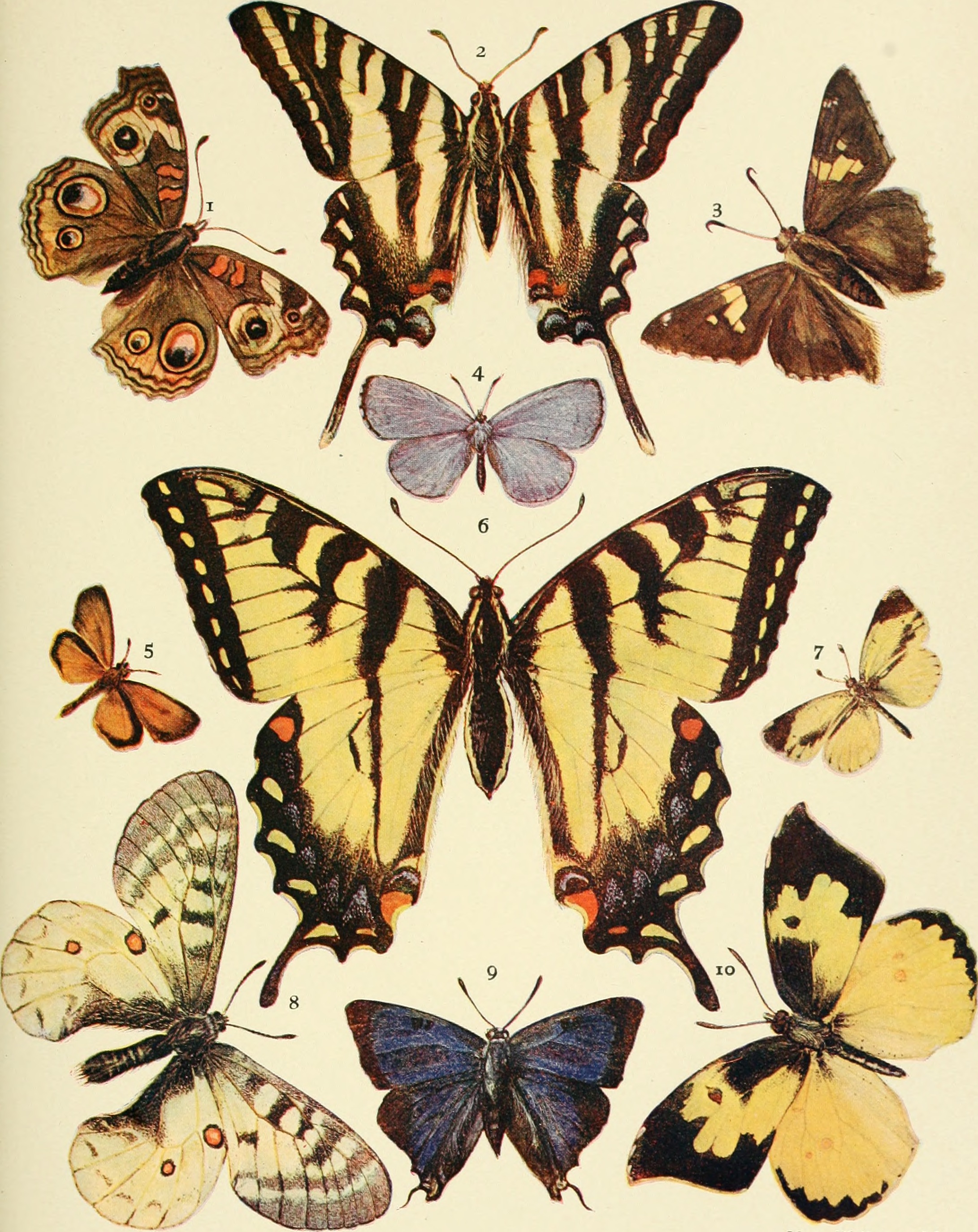
d pattern of the insects aredue. In Chapter XVII will be found a detailed account of these scales,explaining their structure, their origin, and how they produce the color pat-terns. The wings themselves are almost always present (in two pairs), thefore wings larger than the hind wings, and with a characteristic venation,in which the modifications, though small, are yet so constant and definitethat they are used successfully as the principal basis for the classificationof the order into families. Another characteristic is the highly modifiedand peculiar condition of the mouth-parts. While in some species the mouth-parts are rudimentary (atrophied) and evidently not functional, in mostthere is a well-developed slender flexible sucking proboscis (Fig. 509) com- 358 PLATE V. BUTTERFLIES. i=Junonia coenia.2=Iphidicles ajax.3=Epargyieus tityrus.4=CyanirLs pseudargiolus.5 = Ancyloiypha numitor.6=Papilio tumus.7=Nathalis iole.8=Parnassius smintheus.9=Thecla halesus.io=Zerene caesonia. PLATE V
Text Appearing After Image:
Mary Welhnan, del. The Moths and Butterflies 359 posed of the two greatly elongate maxillae, so apposed that a groove on theinner face of one fits against a similar groove on the inner face of the other,the two thus forming a perfect tube (Fig. 510). This sucking proboscis, whenextended, may protrude five or sixinches, as in some of the sphinx-moths, or only a fraction of an inch,as in the small moth millers, butwhen not in use it is so compactlycoiled up, watchspring-like, underthe head, and so concealed by apair of hairy little tippets (the labialpalpi) which project up on eachside of it that it is nearly invisible.Of the other mouth - parts, theupper lip (labrum) and under lip(labium) are greatly reduced andare not movable and flap-like as inmost insects, while the mandiblesare either wholly wanting or, as inthe sphinx-moths and some others,represented only by small immov-able functionless rudiments. Thepalpi of the maxillae are also eitherwholly wanting or present as mererudiments

Note About Images

Please note that these images are extracted from scanned page images that may have been digitally enhanced for readability - coloration and appearance of these illustrations may not perfectly resemble the original work.
Date
Source https://www.flickr.com/photos/internetarchivebookimages/14578562319/
Author Internet Archive Book Images
Permission
(Reusing this file)

At the time of upload, the image license was automatically confirmed using the Flickr API. For more information see Flickr API detail.

Flickr tags
  • bookid:americaninsects00kellog
  • bookyear:1905
  • bookdecade:1900
  • bookcentury:1900
  • bookauthor:Kellogg__Vernon_L___Vernon_Lyman___1867_1937
  • booksubject:Insects
  • bookpublisher:New_York__H__Holt_and_Company
  • bookcontributor:Smithsonian_Institution_Libraries
  • booksponsor:Smithsonian
  • bookleafnumber:392
  • bookcollection:biodiversity
  • bookcollection:americana
  • BHL Collection
  • BHL Consortium
  • bookcontributor:Smithsonian_Libraries
  • booksponsor:Smithsonian_Libraries
Flickr posted date


Licensingedit

This image was taken from Flickr's The Commons. The uploading organization may have various reasons for determining that no known copyright restrictions exist, such as:
  1. The copyright is in the public domain because it has expired;
  2. The copyright was injected into the public domain for other reasons, such as failure to adhere to required formalities or conditions;
  3. The institution owns the copyright but is not interested in exercising control; or
  4. The institution has legal rights sufficient to authorize others to use the work without restrictions.

More information can be found at https://flickr.com/commons/usage/.


Please add additional copyright tags to this image if more specific information about copyright status can be determined. See Commons:Licensing for more information.
Checked copyright icon.svg This image was originally posted to Flickr by Internet Archive Book Images at https://flickr.com/photos/126377022@N07/14578562319. It was reviewed on by FlickreviewR and was confirmed to be licensed under the terms of the No known copyright restrictions.

Photo's description:
Identifier: americaninsects00kellog (find matches) Title: American insects Year: 1905 (1900s) Authors: Kellogg, Vernon L. (Vernon Lyman), 1867-1937 Subjects: Insects Publisher: New York, H. Holt and Company Contributing Library: Smithsonian Libraries Digitizing Sponsor: Smithsonian Libraries View Book Page: Book Viewer About This Book: Catalog Entry View All Images: All Images From Book Click here to view book online to see this illustration in context in a browseable online version of this book. Text Appearing Before Image: d pattern of the insects aredue. In Chapter XVII will be found a detailed account of these scales,explaining their structure, their origin, and how they produce the color pat-terns. The wings themselves are almost always present (in two pairs), thefore wings larger than the hind wings, and with a characteristic venation,in which the modifications, though small, are yet so constant and definitethat they are used successfully as the principal basis for the classificationof the order into families. Another characteristic is the highly modifiedand peculiar condition of the mouth-parts. While in some species the mouth-parts are rudimentary (atrophied) and evidently not functional, in mostthere is a well-developed slender flexible sucking proboscis (Fig. 509) com- 358 PLATE V. BUTTERFLIES. i=Junonia coenia.2=Iphidicles ajax.3=Epargyieus tityrus.4=CyanirLs pseudargiolus.5 = Ancyloiypha numitor.6=Papilio tumus.7=Nathalis iole.8=Parnassius smintheus.9=Thecla halesus.io=Zerene caesonia. PLATE V Text Appearing After Image: Mary Welhnan, del. The Moths and Butterflies 359 posed of the two greatly elongate maxillae, so apposed that a groove on theinner face of one fits against a similar groove on the inner face of the other,the two thus forming a perfect tube (Fig. 510). This sucking proboscis, whenextended, may protrude five or sixinches, as in some of the sphinx-moths, or only a fraction of an inch,as in the small moth millers, butwhen not in use it
Licensing:
Public Domain


Only registered users can post comments. Please login.


EXIF data:
File name american_insects__1905___14578562319_.jpg
Size, Mbytes 1.2725595703125
Mime type image/jpeg


The pictures at Free-Photos.biz come mainly from Wikimedia Commons or from our own production. The images are either in the public domain, or licensed under free linceses: Free-Photos.biz license, GPL, Creative Commons or Free-Art license. Some very few other photos where uploaded to Free-Photos.biz by our users and released into the public domain or into free usage under another free license (like GPL etc.)

While the copyright and licensing information supplied for each photo is believed to be accurate, Free-Photos.biz does not provide any warranty regarding the copyright status or correctness of licensing terms. If you decide to reuse the images from Free-Photos.biz, you should verify the copyright status of each image just as you would when obtaining images from other sources.


The use of depictions of living or deceased persons may be restricted in some jurisdictions by laws regarding personality rights. Such images are exhibited at Free-Photos.biz as works of art that serve higher artistic interests.

PRIVACY POLICY


By registering your account and/or by subscribing to new and newly rated photographs you agree we may send you the links to photos and we may occasionally share other information with you.

We do NOT disclose your personal data.



christianity portal