
Please login in order to download photos in full size
If you are not registered, please register for free: www.Free-Photos.biz/register
Please note to download premium images you also need to join as a free member..
You can also save the photos without the registration - but only in small and average sizes, and some of them will have the site's watermark. Please simply click your right mouse button and save the image.
Please login in order to like photos
If you are not registered, please register for free:
Sorry, non-members can download up to 100 full-size photos per month.
It looks like you have used up your limit.
Free members can download an unlimited number of full-size photos - including the premium free photos.
Join as a member today for FREE! - and download the images without limitations:
www.Free-Photos.biz/membership.php
You can also save the images without the membership - but only in small and average sizes, and some of them may have the site's watermark. Please simply click your right mouse button and save the image.
|

Download top free photographs!
This photo was viewed 12 times and was downloaded in full size 10 times.
This photo was liked 0 times


If you are a member, please login in order to see the source link of the above image.
| Description |
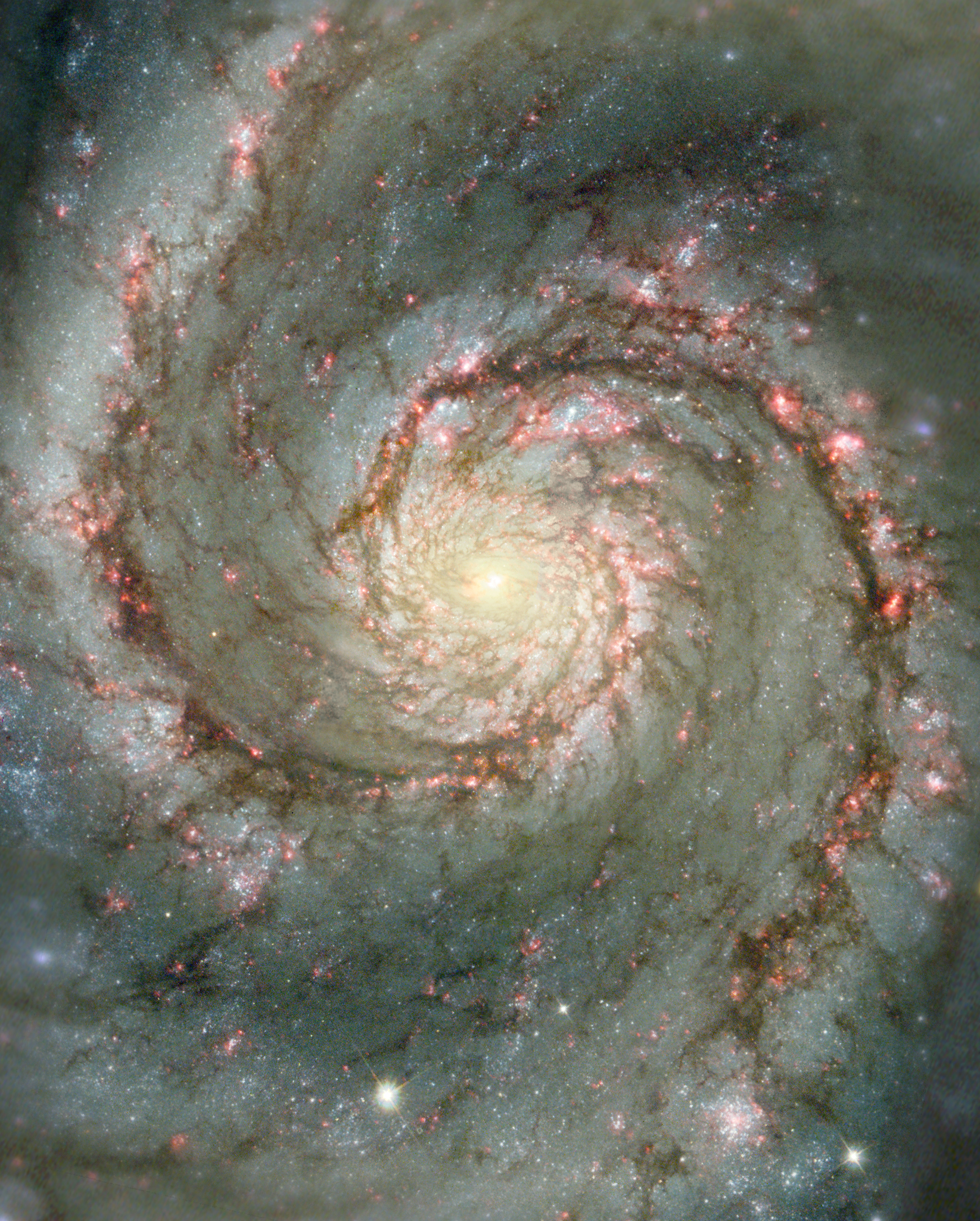
English: This Hubble composite image shows visible starlight as well as light from the emission of glowing hydrogen, which is associated with the most luminous young stars in the spiral arms.
The Whirlpool Galaxy, also known as M51 or NGC 5194, is having a close encounter with a nearby companion galaxy, NGC 5195, just off the upper edge of this image. The companion's gravitational pull is triggering star formation in the main galaxy, as seen in brilliant detail by numerous, luminous clusters of young and energetic stars. The bright clusters are highlighted in red by their associated emission from glowing hydrogen gas. This Wide Field Planetary Camera 2 image enables researchers to clearly define the structure of both the cold dust clouds and the hot hydrogen and link individual clusters to their parent dust clouds. Intricate structure is also seen for the first time in the dust clouds. Along the spiral arms, dust "spurs" are seen branching out almost perpendicular to the main spiral arms. The regularity and large number of these features suggests to astronomers that previous models of "two-arm" spiral galaxies may need to be revisited. The new images also reveal a dust disk in the nucleus, which may provide fuel for a nuclear black hole. |
|||
| Date | 5 April 2001 | |||
| Source | https://hubblesite.org/newscenter/archive/releases/2001/10/image/a/ (direct link) | |||
| Author | NASA and The Hubble Heritage Team (STScI/AURA) | |||
| Permission (Reusing this file) |
|


Public Domain
| EXIF data: | |
| File name | whirpool_galaxy.jpg |
|---|---|
| Size, Mbytes | 4.5001640625 |
| Mime type | image/jpeg |
While the copyright and licensing information supplied for each photo is believed to be accurate, Free-Photos.biz does not provide any warranty regarding the copyright status or correctness of licensing terms. If you decide to reuse the images from Free-Photos.biz, you should verify the copyright status of each image just as you would when obtaining images from other sources.
The use of depictions of living or deceased persons may be restricted in some jurisdictions by laws regarding personality rights. Such images are exhibited at Free-Photos.biz as works of art that serve higher artistic interests.
PRIVACY POLICY
By registering your account and/or by subscribing to new and newly rated photographs you agree we may send you the links to photos and we may occasionally share other information with you.
We do NOT disclose your personal data.
