
Please login in order to download photos in full size
If you are not registered, please register for free: www.Free-Photos.biz/register
Please note to download premium images you also need to join as a free member..
You can also save the photos without the registration - but only in small and average sizes, and some of them will have the site's watermark. Please simply click your right mouse button and save the image.
Please login in order to like photos
If you are not registered, please register for free:
Sorry, non-members can download up to 100 full-size photos per month.
It looks like you have used up your limit.
Free members can download an unlimited number of full-size photos - including the premium free photos.
Join as a member today for FREE! - and download the images without limitations:
www.Free-Photos.biz/membership.php
You can also save the images without the membership - but only in small and average sizes, and some of them may have the site's watermark. Please simply click your right mouse button and save the image.
|

Download top free photographs!
This photo was viewed 5 times and was downloaded in full size 1 times.
This photo was liked 0 times


If you are a member, please login in order to see the source link of the above image.
Summary
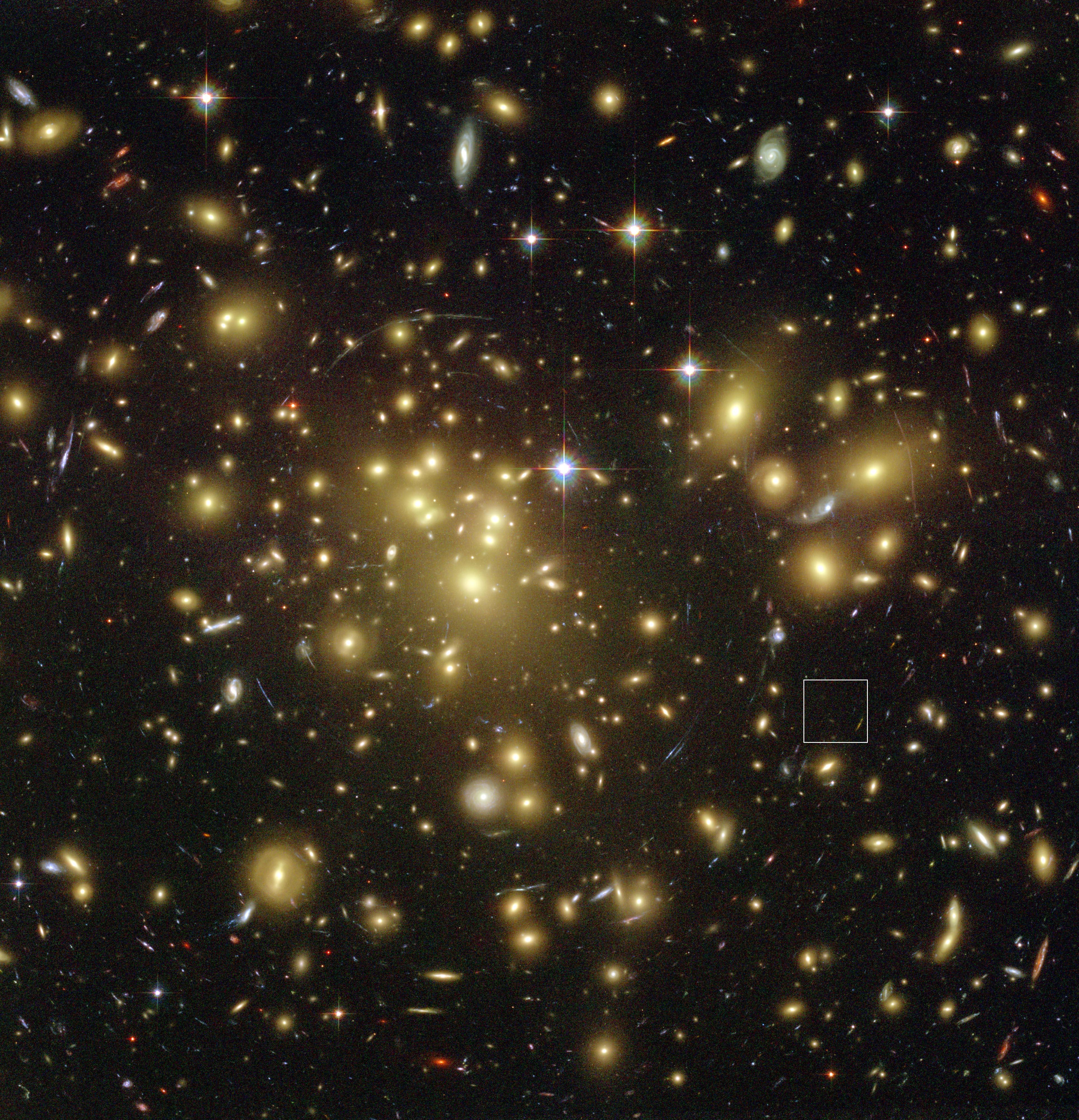
| Description | In the white square is A 1689-zD1, the most distant and therefore oldest known galaxy discovered as of February 2008. (ref:([1])
Picture's original description: A massive cluster of yellowish galaxies, seemingly caught in a red and blue spider web of eerily distorted background galaxies, makes for a spellbinding picture from the new Advanced Camera for Surveys aboard NASA's Hubble Space Telescope. To make this unprecedented image of the cosmos, Hubble peered straight through the center of one of the most massive galaxy clusters known, called Abell 1689. The gravity of the cluster's trillion stars — plus dark matter — acts as a 2-million-light-year-wide lens in space. This gravitational lens bends and magnifies the light of the galaxies located far behind it. Some of the faintest objects in the picture are probably over 13 billion light-years away (redshift value 6). |
| Date | 2010-01-16 02:01 (UTC) |
| Source | |
| Author |
|
|


![[1]](https://estaticos01.cache.el-mundo.net/elmundo/imagenes/2008/02/13/1202864356_0.jpg)

Original upload log
This image is a derivative work of the following images:
- File:Gravitationell-lins-4.jpg licensed with PD-Hubble
- 2009-06-19T18:10:01Z Tryphon 3853x4000 (3740896 Bytes) Higher resolution.
- 2007-02-28T20:32:32Z Nicke L 400x359 (71811 Bytes) {{Information |Description=Gravitationell lins, Hubbleteleskopet, Abellgruppen *CREDIT: NASA, N. Benitez (JHU), T. Broadhurst (Racah Institute of Physics/The Hebrew University), H. Ford (JHU), M. Clampin (STScI),G. Hartig (ST
Uploaded with derivativeFX
Public Domain
| EXIF data: | |
| File name | a1689-zd1_2.jpg |
|---|---|
| Size, Mbytes | 3.511818359375 |
| Mime type | image/jpeg |
| Orientation of image | 1 |
| Image resolution in width direction | 300 |
| Image resolution in height direction | 300 |
| Unit of X and Y resolution | 2 |
| Color space information | 65535 |
| Exif image width | 3853 |
| Exif image length | 4000 |
| Software used | Adobe Photoshop 7.0 |
While the copyright and licensing information supplied for each photo is believed to be accurate, Free-Photos.biz does not provide any warranty regarding the copyright status or correctness of licensing terms. If you decide to reuse the images from Free-Photos.biz, you should verify the copyright status of each image just as you would when obtaining images from other sources.
The use of depictions of living or deceased persons may be restricted in some jurisdictions by laws regarding personality rights. Such images are exhibited at Free-Photos.biz as works of art that serve higher artistic interests.
PRIVACY POLICY
By registering your account and/or by subscribing to new and newly rated photographs you agree we may send you the links to photos and we may occasionally share other information with you.
We do NOT disclose your personal data.
