
Please login in order to download photos in full size
If you are not registered, please register for free: www.Free-Photos.biz/register
Please note to download premium images you also need to join as a free member..
You can also save the photos without the registration - but only in small and average sizes, and some of them will have the site's watermark. Please simply click your right mouse button and save the image.
Please login in order to like photos
If you are not registered, please register for free:
Sorry, non-members can download up to 100 full-size photos per month.
It looks like you have used up your limit.
Free members can download an unlimited number of full-size photos - including the premium free photos.
Join as a member today for FREE! - and download the images without limitations:
www.Free-Photos.biz/membership.php
You can also save the images without the membership - but only in small and average sizes, and some of them may have the site's watermark. Please simply click your right mouse button and save the image.
|

Download top free photographs!
This photo was viewed 5 times and was downloaded in full size 2 times.
This photo was liked 0 times


If you are a member, please login in order to see the source link of the above image.
Summaryedit

| Description |
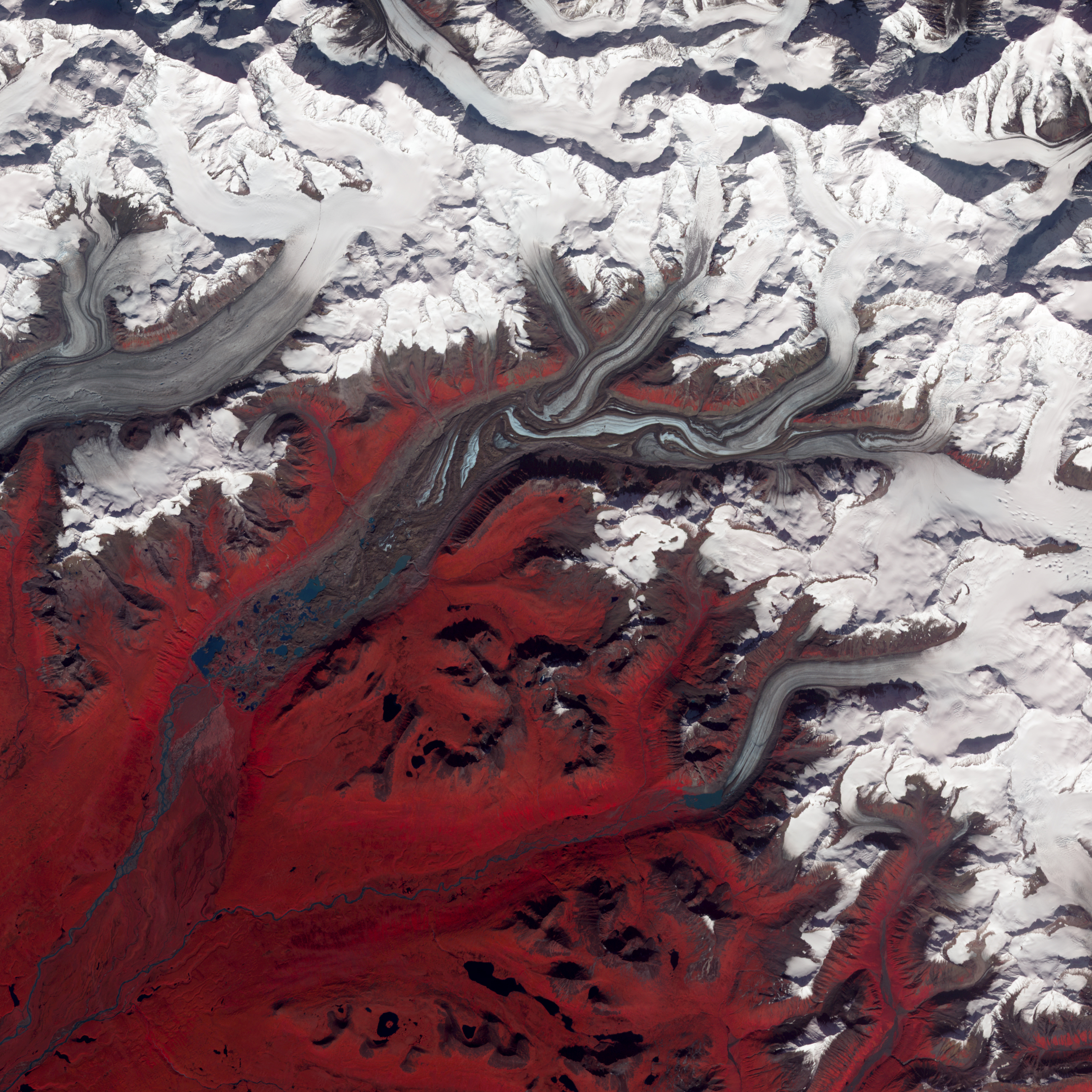
English: This false-colour image of Susitna Glacier looks similar to an areal photograph, except that vegetation is red. Susitna Glacier’s surface is marbled, combining dirt-free pale blue and dirt-coated dark brown ice. Infusions of relatively clean ice push into the glacier from tributaries flowing from the north. The glacier surface appears especially complex near the centre of the image, where ice from a tributary has pushed ice in the main glacier slightly southward. Susitna Glacier flows over a seismically active area. In fact, a 7.9-magnitude quake struck the region in November 2002, along the previously unknown Susitna Glacier fault. Although geologists surmised that this and other earthquakes left steep cliffs and slopes on the glacier surface, the complex glacial surface apparent in this image results from surges of tributary glaciers. Glacier surges—typically short-lived events where a glacier moves many times its normal rate—can occur when melt-water accumulates at the base of the glacier. The water provides lubrication that quickens flow. This water may be supplied by melt-water lakes that accumulate on top of the glacier, and melt ponds appear on the Susitna Glacier, in the lower left corner of this image. The nature of the underlying bedrock might also contribute to glacier surges, with soft, easily deformed rock leading to more frequent surges.
|
| Date | |
| Source | NASA Earth Observatory |
| Author | Jesse Allen and Robert Simmon |
Image captured by the Advanced Spaceborne Thermal Emission and Reflection Radiometer (ASTER) on NASA’s Terra satellite. Data provided courtesy of NASA/GSFC/METI/ERSDAC/JAROS, and U.S./Japan ASTER Science Team.
Licensingedit

 |
This file is in the public domain because it was solely created by NASA. NASA copyright policy states that "NASA material is not protected by copyright unless noted". (See Template:PD-USGov, NASA copyright policy page or JPL Image Use Policy.) |
 |
 |
Warnings:
|
This false-colour image of Susitna Glacier looks similar to an areal photograph, except that vegetation is red. Susitna Glacier’s surface is marbled, combining dirt-free pale blue and dirt-coated dark brown ice. Infusions of relatively clean ice push into the glacier from tributaries flowing from the north. The glacier surface appears especially complex near the centre of the image, where ice from a tributary has pushed ice in the main glacier slightly southward. Susitna Glacier flows over a seismically active area. In fact, a 7.9-magnitude quake struck the region in November 2002, along the previously unknown Susitna Glacier fault. Although geologists surmised that this and other earthquakes left steep cliffs and slopes on the glacier surface, the complex glacial surface apparent in this image results from surges of tributary glaciers. Glacier surges—typically short-lived events where a glacier moves many times its normal rate—can occur when melt-water accumulates at the base of the glacier. The water provides lubrication that quickens flow. This water may be supplied by melt-water lakes that accumulate on top of the glacier, and melt ponds appear on the Susitna Glacier, in the lower left corner of this image. The nature of the underlying bedrock might also contribute to glacier surges, with soft, easily deformed rock leading to more frequent surges.
Public Domain
| EXIF data: | |
| File name | susitna_glacier__alaska.jpg |
|---|---|
| Size, Mbytes | 5.6723212890625 |
| Mime type | image/jpeg |
| Orientation of image | 1 |
| Image resolution in width direction | 100 |
| Image resolution in height direction | 100 |
| Unit of X and Y resolution | 2 |
| Color space information | 65535 |
| Exif image width | 2600 |
| Exif image length | 2600 |
| Software used | Adobe Photoshop CS5 Macintosh |
While the copyright and licensing information supplied for each photo is believed to be accurate, Free-Photos.biz does not provide any warranty regarding the copyright status or correctness of licensing terms. If you decide to reuse the images from Free-Photos.biz, you should verify the copyright status of each image just as you would when obtaining images from other sources.
The use of depictions of living or deceased persons may be restricted in some jurisdictions by laws regarding personality rights. Such images are exhibited at Free-Photos.biz as works of art that serve higher artistic interests.
PRIVACY POLICY
By registering your account and/or by subscribing to new and newly rated photographs you agree we may send you the links to photos and we may occasionally share other information with you.
We do NOT disclose your personal data.
