
Please login in order to download photos in full size
If you are not registered, please register for free: www.Free-Photos.biz/register
Please note to download premium images you also need to join as a free member..
You can also save the photos without the registration - but only in small and average sizes, and some of them will have the site's watermark. Please simply click your right mouse button and save the image.
Please login in order to like photos
If you are not registered, please register for free:
Sorry, non-members can download up to 100 full-size photos per month.
It looks like you have used up your limit.
Free members can download an unlimited number of full-size photos - including the premium free photos.
Join as a member today for FREE! - and download the images without limitations:
www.Free-Photos.biz/membership.php
You can also save the images without the membership - but only in small and average sizes, and some of them may have the site's watermark. Please simply click your right mouse button and save the image.
|

Download top free photographs!
This photo was viewed 6 times and was downloaded in full size 6 times.
This photo was liked 0 times


If you are a member, please login in order to see the source link of the above image.
| Description | Dimensions of Written Surface: Recto: 13.8 (w) x 24.7 (h) cm
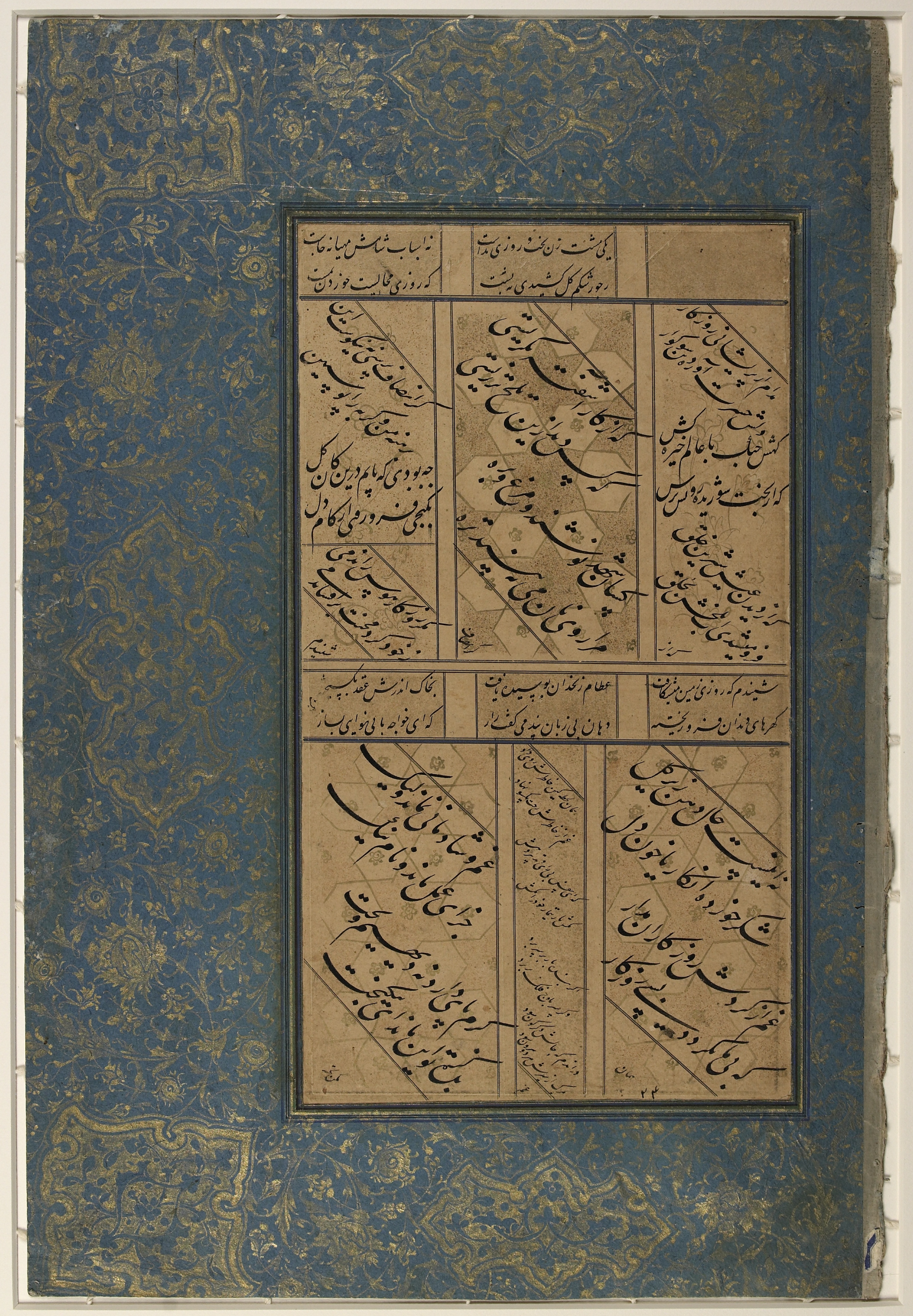
Dimensions of Written Surface: Verso: 14 (w) x 25 (h) cm Script: nasta'liq This fragment includes an excerpt from Sa'di's (d. 691/1292) Bustan (The Fruit Orchard), in which he offers advice (nasihat) to a ruler. The author counsels a king not to worry about what he does not have, because all things come to an end. He also notes that good deeds matter, as only a man's reputation and memory remain. Sa'di's text continues on the fragment's verso (1-86-154.140 V), as evidenced by the similar subject matter and the continuation of the catchwords (makun takiyah) in the lower left corner of the recto. The calligraphic fragment is executed in black nasta'liq script in horizontal and diagonal lines on a beige folio decorated with polygonal motifs highlighted in gold. Various text panels are framed by simple borders, creating a complex web of verses in a quilt-like pattern. The text panel is framed by several borders and pasted to blue paper decorated with flower and medallion motifs painted in gold. The folio's layout and style are typical of works produced in Safavid Persia (Iran) during the 16th century. The number 24 appears in the lower right corner of the text panel, while the number 25 appears on the fragment's verso. These numbers suggest that these two calligraphic fragments belonged to a larger work, either a more complete copy of Sa'di's Bustan or an album of calligraphies. The verso of this fragment also includes an excerpt from Sa'di's Bustan in which he offers advice to a ruler. It continues the text on the fragment's recto, as noted by the similar subject and the catchword in the recto's lower left corner (1-86-154.140 R). The verses here read: Makun takiyah bar mulk u jah u hasham / Ka pish az tu bud ast u ba'd az tu ham / Khudavand-i dawlat gham u din khurad / Ka dunya bi-har hal mibiguzarad / Nakhwahi ka mulkat barayad bi-ham / Gham-i mulk u din khurd bayad bi-ham Don't lean on rulership, glory, and (your) retinue / Which were there before you and (will be there) after you. / The Lord of Government has to pay attention to religion / Because the world certainly will end. / If you don't want your kingdom to disappear with it, / Then be aware both of power and religion, as they go together. Here, Sa'di warns a ruler that he must respect both earthly power (mulk) and spiritual affairs (din), as they complement each other. Much like God (khuda) supervises religious well-being, the king too, as "Lord of Government" (khudavand-i dawlat) must administer wisely. The verso of this calligraphic fragment is executed in a large, crisp nasta'liq script in black ink on a beige folio framed by several borders and pasted to cream-colored paper decorated with flower and vine motifs painted in gold. The layout and style of the pages are typical of works produced in Safavid Persia (Iran) during the 16th century. |
||||
| Date | 16th century | ||||
| Source |
|
||||
| Author | Unknown | ||||
| Permission (Reusing this file) |
|
||||
| Other versions |

|
||||


Public Domain
| EXIF data: | |
| File name | nasihat_recto.jpg |
|---|---|
| Size, Mbytes | 5.929283203125 |
| Mime type | image/jpeg |
While the copyright and licensing information supplied for each photo is believed to be accurate, Free-Photos.biz does not provide any warranty regarding the copyright status or correctness of licensing terms. If you decide to reuse the images from Free-Photos.biz, you should verify the copyright status of each image just as you would when obtaining images from other sources.
The use of depictions of living or deceased persons may be restricted in some jurisdictions by laws regarding personality rights. Such images are exhibited at Free-Photos.biz as works of art that serve higher artistic interests.
PRIVACY POLICY
By registering your account and/or by subscribing to new and newly rated photographs you agree we may send you the links to photos and we may occasionally share other information with you.
We do NOT disclose your personal data.
