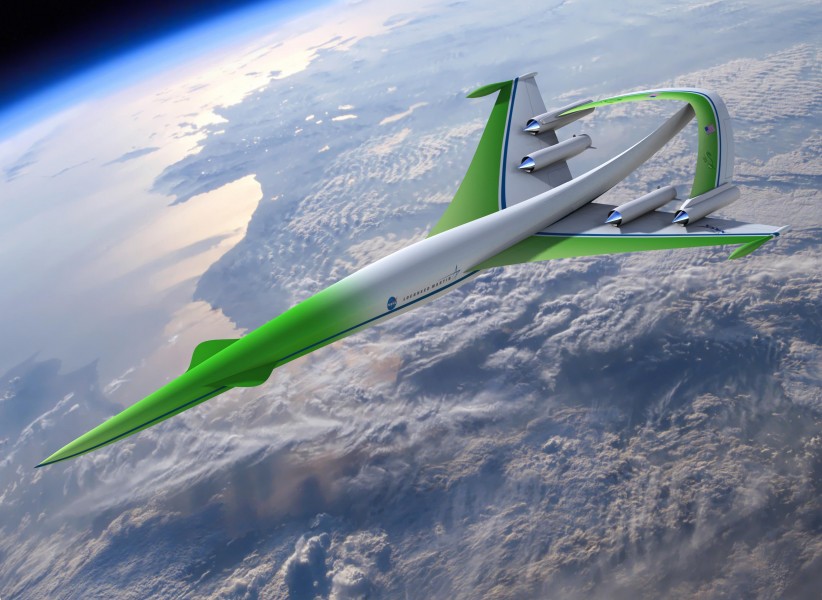
This future aircraft design concept for supersonic flight over land comes from the team led by the Lockheed Martin Corporation.
The team's simulation shows possibility for achieving overland flight by dramatically lowering the level of sonic booms through the use of an
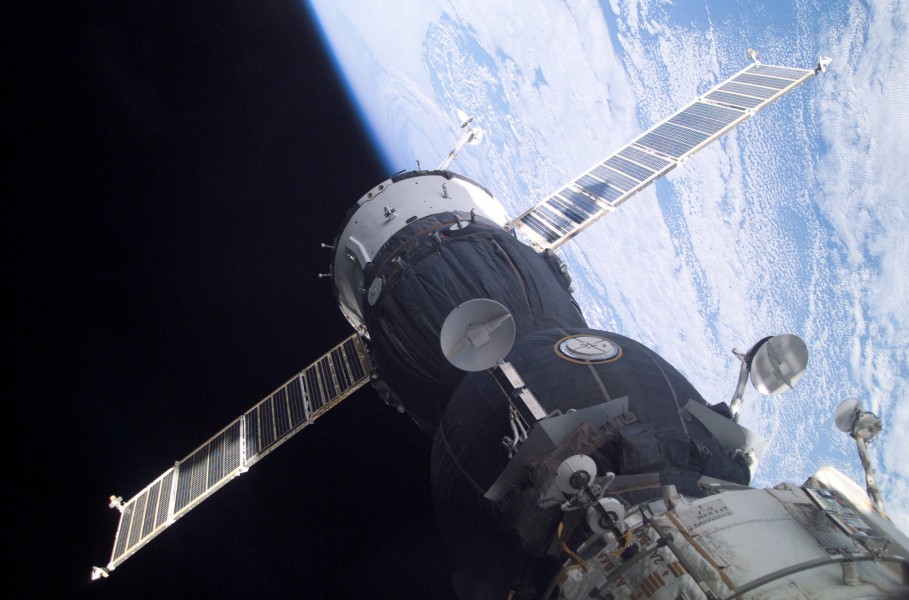
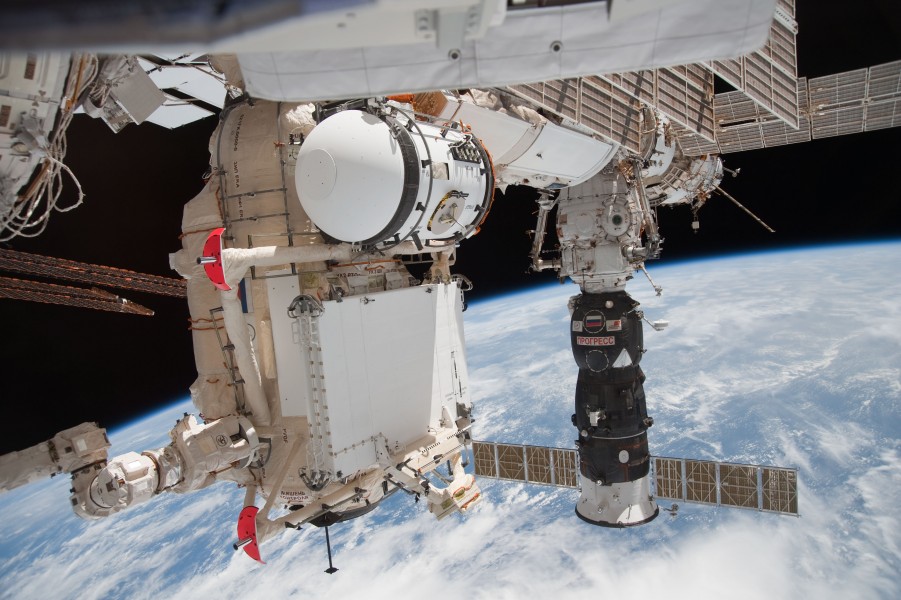
The Soyuz TMA-19 spacecraft, docked to the Rassvet Mini-Research Module 1 (MRM1), is featured in this image photographed by an Expedition 24 crew member on the International Space Station. A blue and white part of Earth and the blackness of space provide the backdrop for the scene.
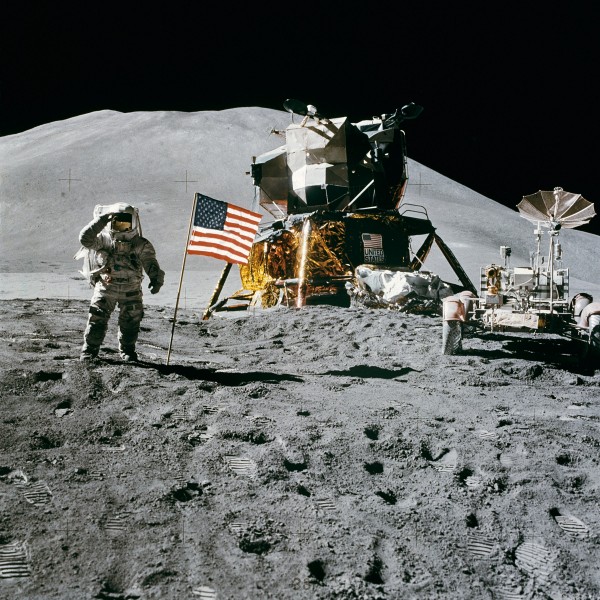
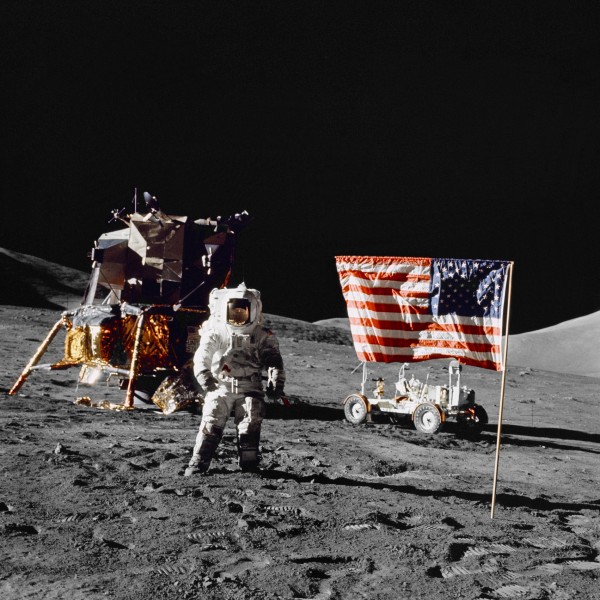
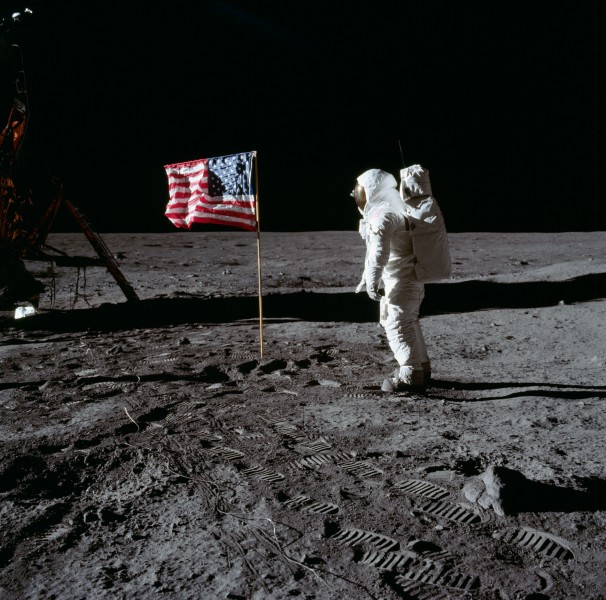
Astronaut Harrison H. Schmitt, lunar module pilot, stands near the deployed United States flag on the lunar surface during Extravehicular Activity (EVA) of NASA's final lunar landing mission in the Apollo series. The Lunar Module (LM) is at left background and the Lunar Roving Vehicle (LRV) at right background (partially obscured). The photo was made by astronaut Eugene A. Cernan, commander.
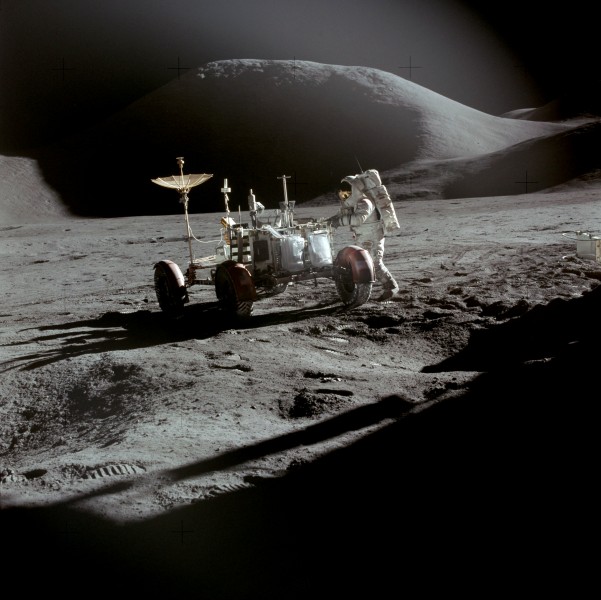
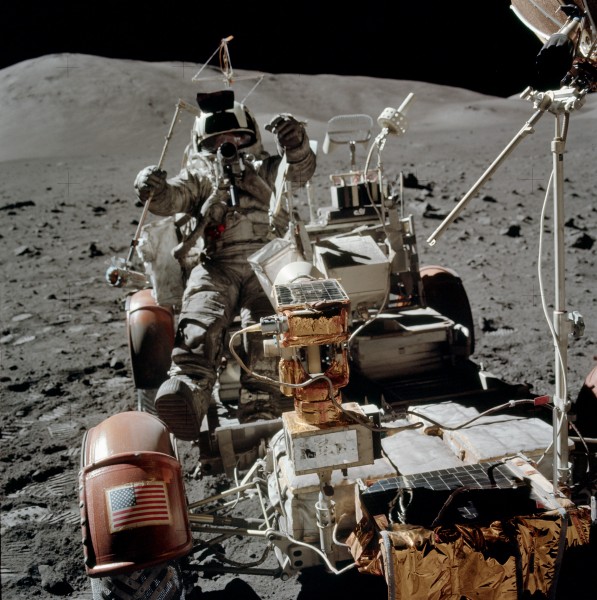
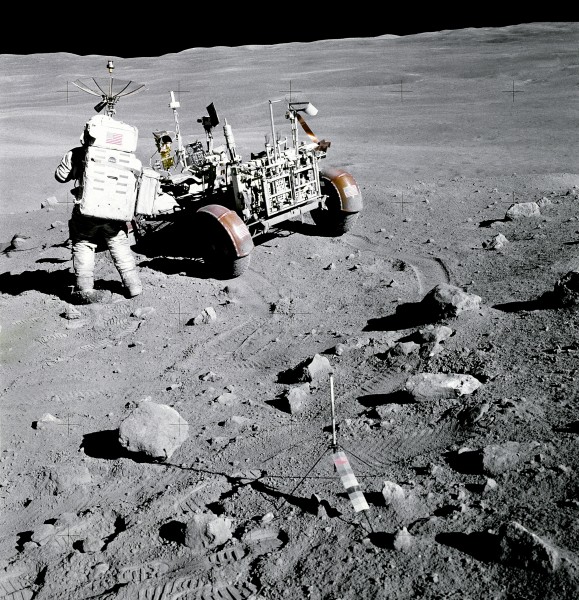
Image from Apollo 15, taken by Commander David Scott at the end of EVA-1. Lunar Module Pilot Jim Irwin is seen with the Lunar Roving Vehicle, with Mount Hadley in the background. Seen on the back of the Rover are two SCBs mounted on the gate, along with the rake, both pairs of tongs, the extension handle with scoop probably attached, and the penetrometer. Note that the TV camera is pointed down, in the stowed position.
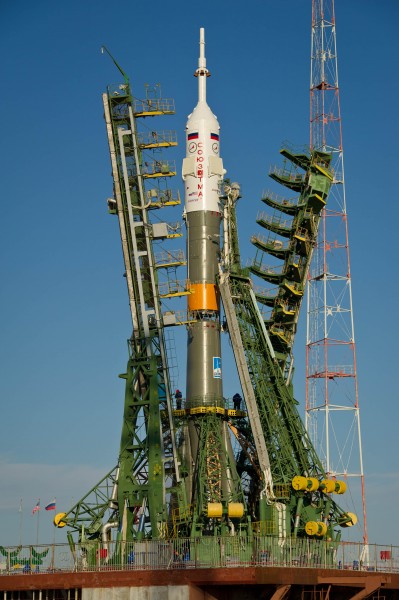
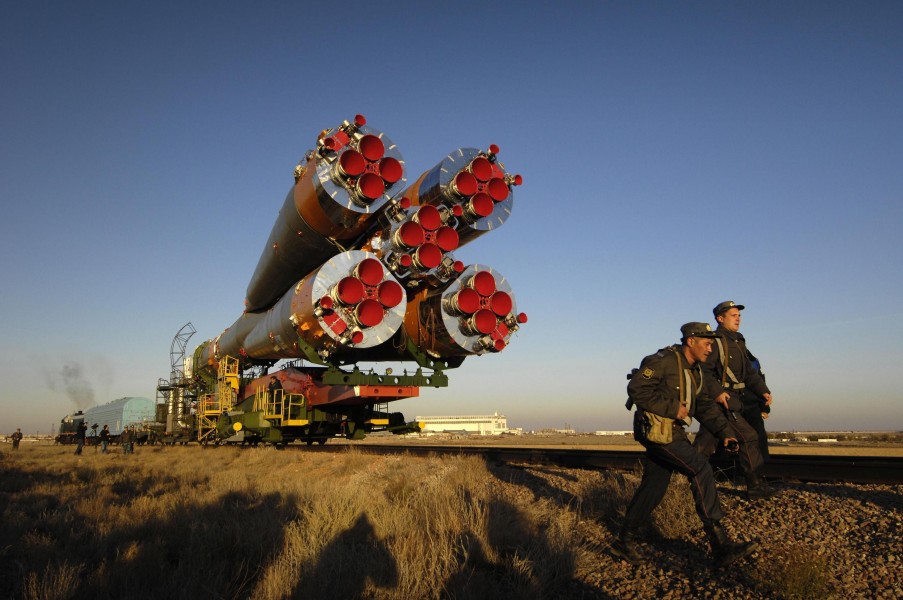
The Soyuz TMA-5 spacecraft is mated to its booster rocket in a processing hangar at the Baikonur Cosmodrome in Kazakhstan October 11, 2004, in preparation for its rollout to the launch pad October 12 and its liftoff October 14 to carry astronaut Leroy Chiao, Expedition 10 commander and NASA International Space Station (ISS) science officer; cosmonaut Salizhan S. Sharipov, Russia’s Federal Space Agency Expedition 10 flight engineer and Soyuz commander; and Russian Space Forces cosmonaut Yuri Shargin to the ISS. Building 112, Baikonur Cosmodrome, Kazakhstan.
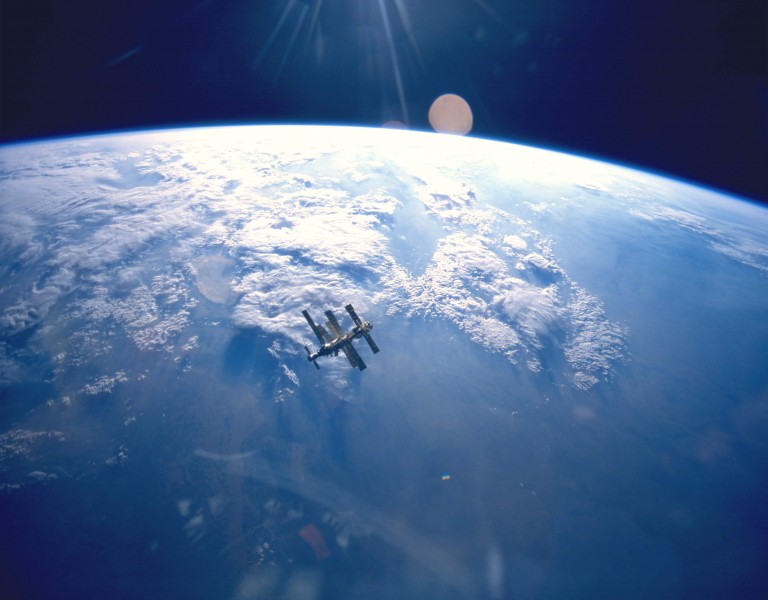
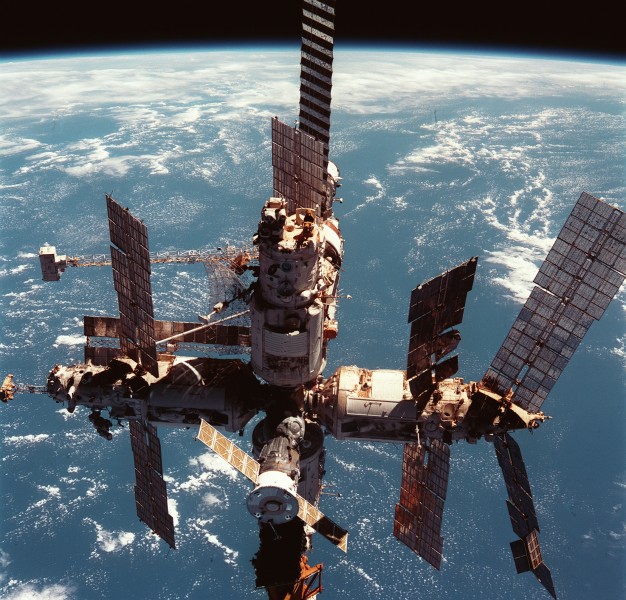
Scenic view of Mir over open ocean, clouds, earth limb.
Image from Apollo 15, taken by Commander David Scott at the end of EVA-1. Lunar Module Pilot Jim Irwin is seen with the Lunar Roving Vehicle, with Mount Hadley in the background. Seen on the back of the Rover are two SCBs mounted on the gate, along with the rake, both pairs of tongs, the extension handle with scoop probably attached, and the penetrometer. Note that the TV camera is pointed down, in the stowed position.
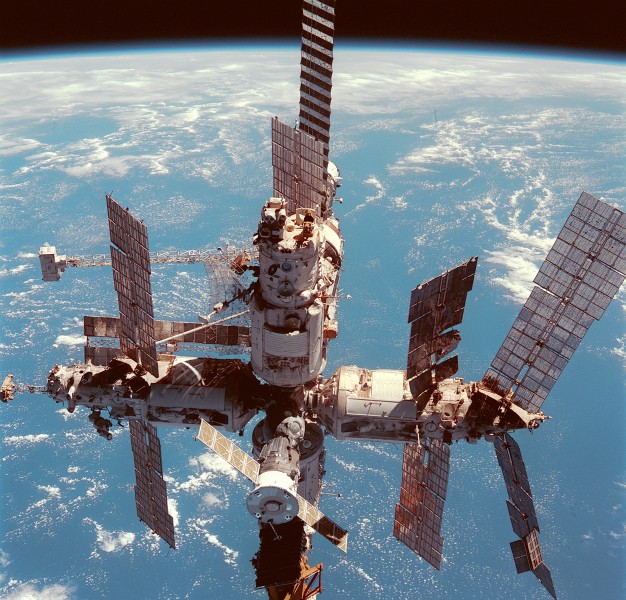
Russia's Mir space station is backdropped over the blue and white planet Earth in this medium range photograph recorded during the final fly-around of the members of the fleet of NASA's shuttles. Seven crew members, including Andrew S.W. Thomas, were aboard the Space Shuttle Discovery when the photo was taken; and two of his former cosmonaut crewmates remained aboard Mir. Thomas ended up spending 141 days in space on this journey, including time aboard Space Shuttles Endeavour and Discovery, which transported him to and from Mir.
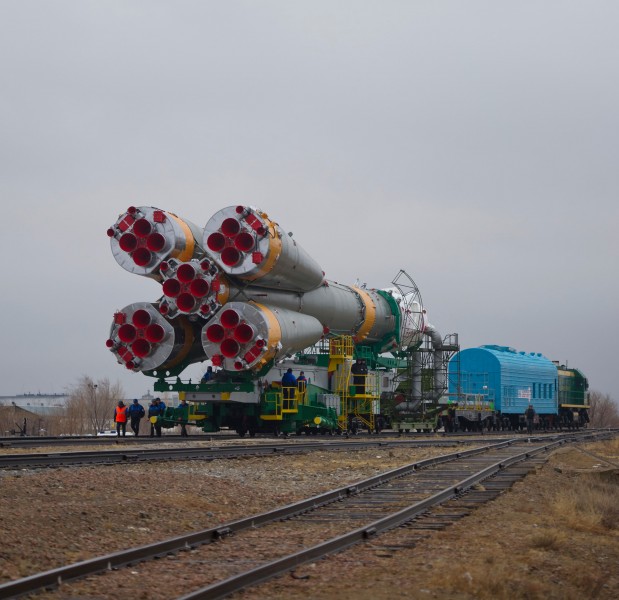
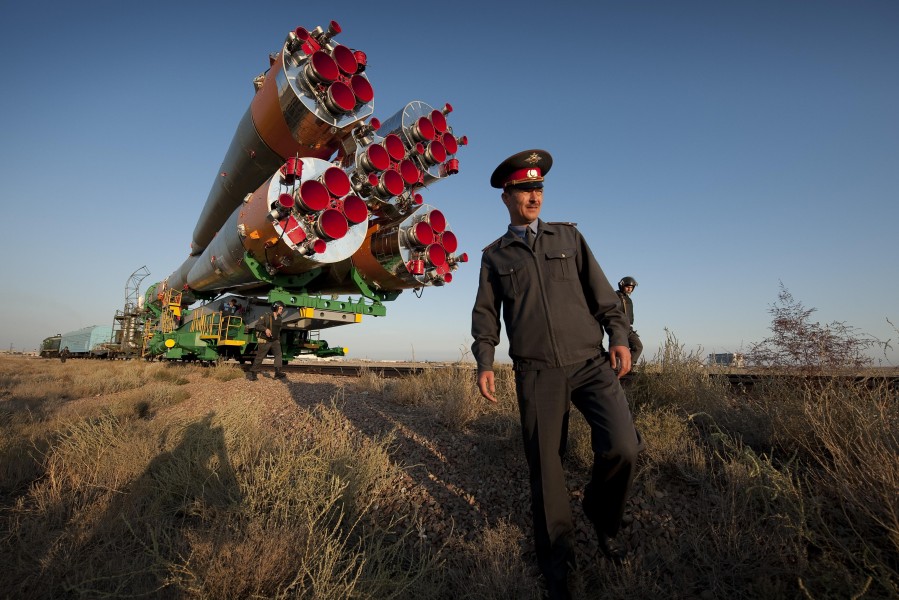
This photo by NASA photographer Bill Ingalls has been honored by United Press International as one of the top pictures of 2007. Ingalls took the photo of the Soyuz TMA-11 spacecraft on Oct. 8 as it was transported by train to its launch pad at the Baikonur Cosmodrome in Kazakhstan.
Russia's Mir space station is backdropped over the blue and white planet Earth in this medium range photograph recorded during the final fly-around of the members of the fleet of NASA's shuttles. Seven crew members, including Andrew S.W. Thomas, were aboard the Discovery when the photo was taken; and two of his former cosmonaut crewmates remained aboard Mir. Thomas ended up spending 141 days in space on this journey, including time aboard the Space Shuttles Endeavour and Discovery, which delivered and retrieved him to and from the Mir.
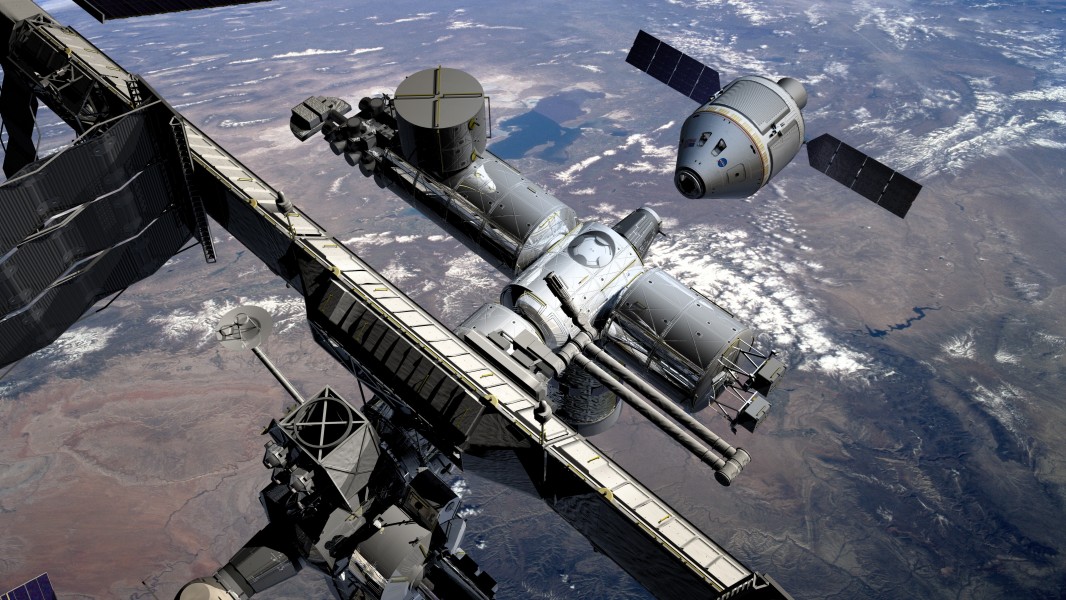
The CEV spacecraft docks to the International Space Station
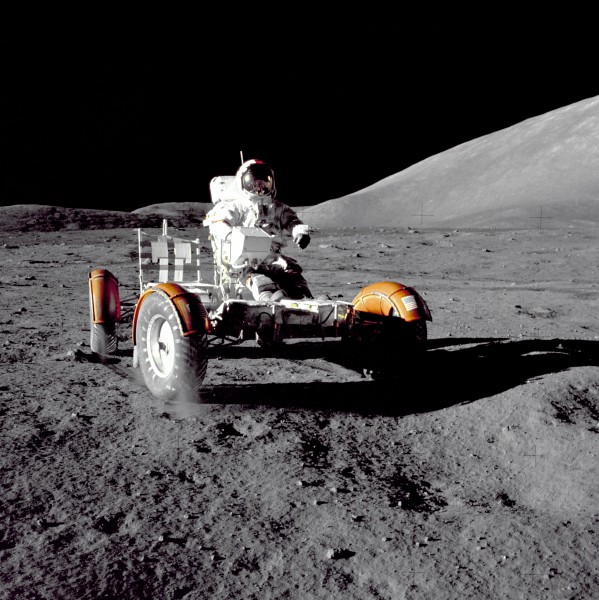
Apollo 17 mission on Moon, 11 December 1972
Astronaut Edward M. (Mike) Fincke, Expedition 9 NASA ISS science officer and flight engineer, wearing a Russian Orlan spacesuit, participates in the third of four sessions of extravehicular activities (EVA) performed by the Expedition 9 crew during their six-month mission. Fincke and cosmonaut Gennady I. Padalka (out of frame), commander representing Russia's Federal Space Agency, spent 4 ½ hours outside the Station swapping out experiments and installing hardware associated with Europe’s Automated Transfer Vehicle (ATV), scheduled to launch on its maiden voyage to ISS next year. A cloudy Earth provided the backdrop for the image. According to a label on his chest, he is wearing a Orlan-M suit.
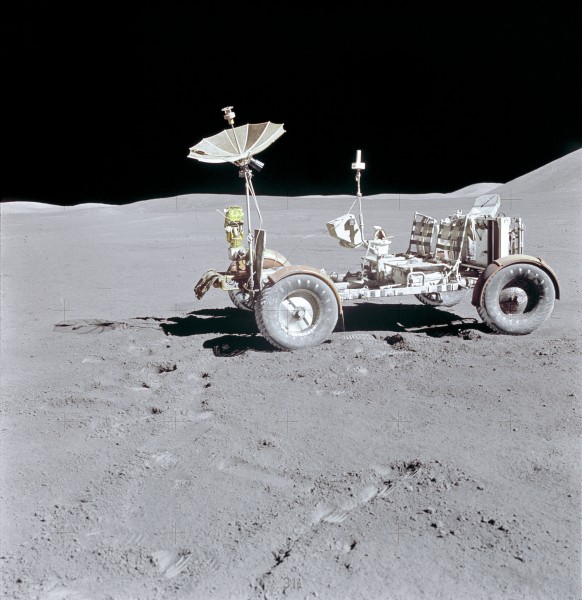
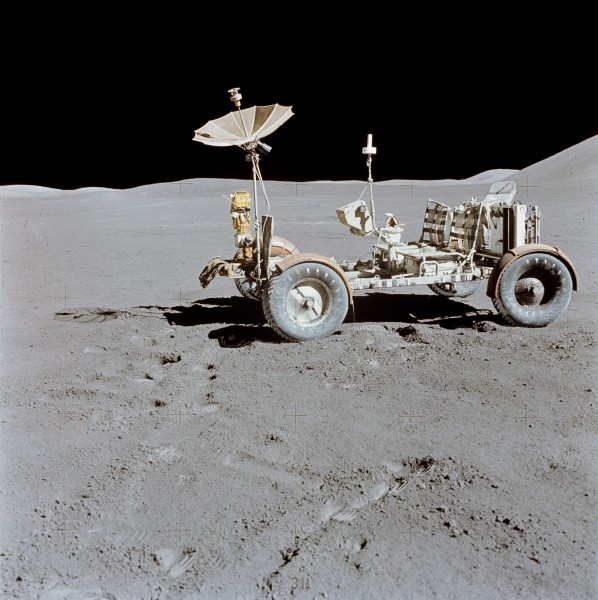
The Lunar Roving Vehicle is photographed alone against the lunar background during the Apollo 15 lunar surface extravehicular activity (EVA) at the Hadley-Apennine landing site. This view is looking north. The west edge of Mount Hadley is at the upper right edge of the picture.Mount Hadley is at the upper right edge of the picture. It rises approximately 4,500 meters (about 14,765 feet) above the plain. The most distant lunar feature visible is approximatley 25 kilometers (about 15.5 statute miles) away.
Our hearts were racing as we heard the radio broadcast of the countdown from the launch control officer thousands of feet away?
In case this is not legally possible:
Arie grants anyone the right to use this work for any purpose, without any conditions, unless such conditions are required by law.
mir_on_24_september_1996.jpg
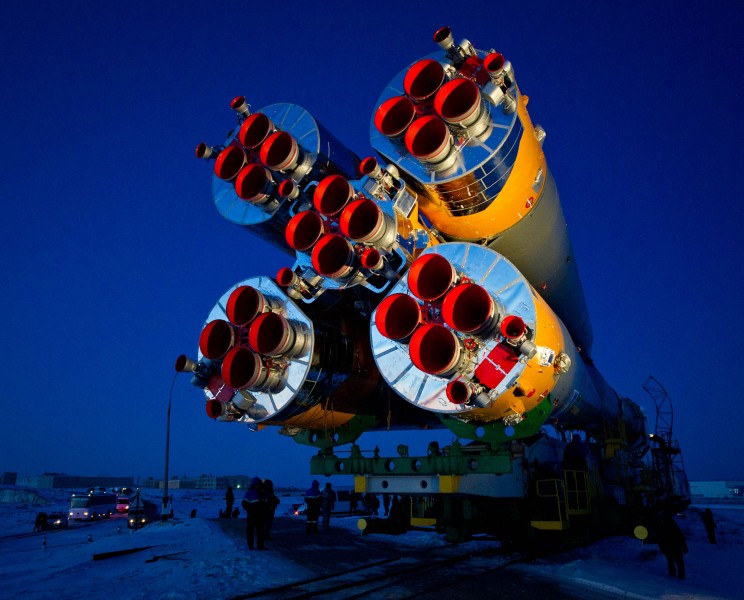
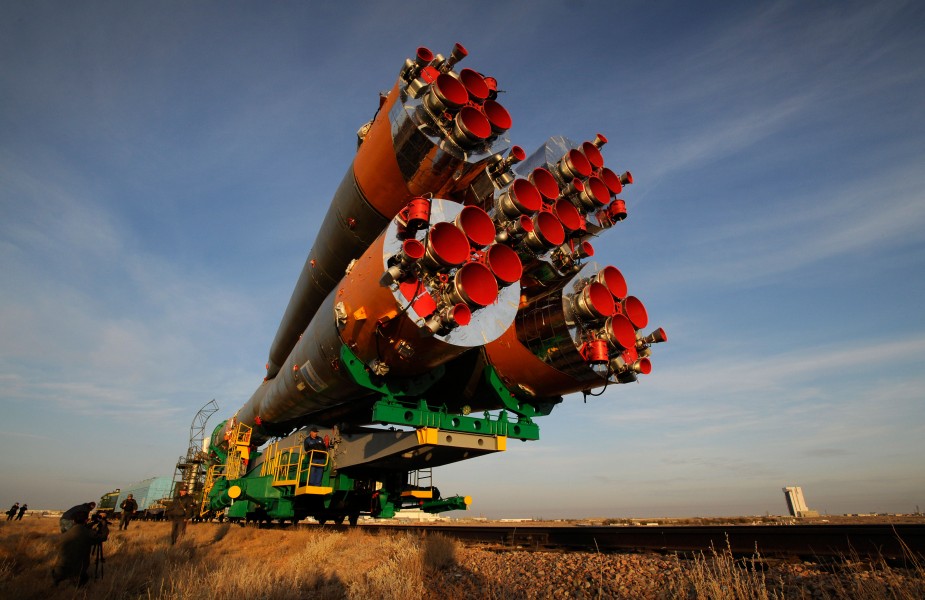
View of the Soyuz rocket engines. Engineers at the Baikonur Cosmodrome in Kazakhstan mated the Soyuz TMA-4 capsule with its booster rocket on April 16, 2004, in preparation for launch of the Expedition 9 crew and a European Space Agency (ESA) astronaut to the International Space Station (ISS) on April 19. The rocket rolled to its launch pad in Baikonur on April 17 for final preparations for its launch.
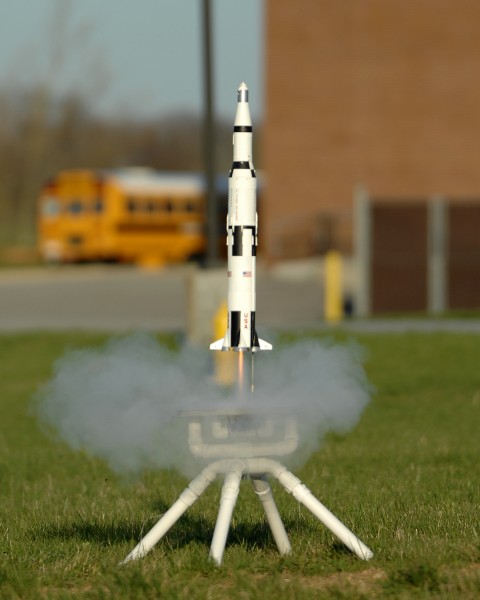
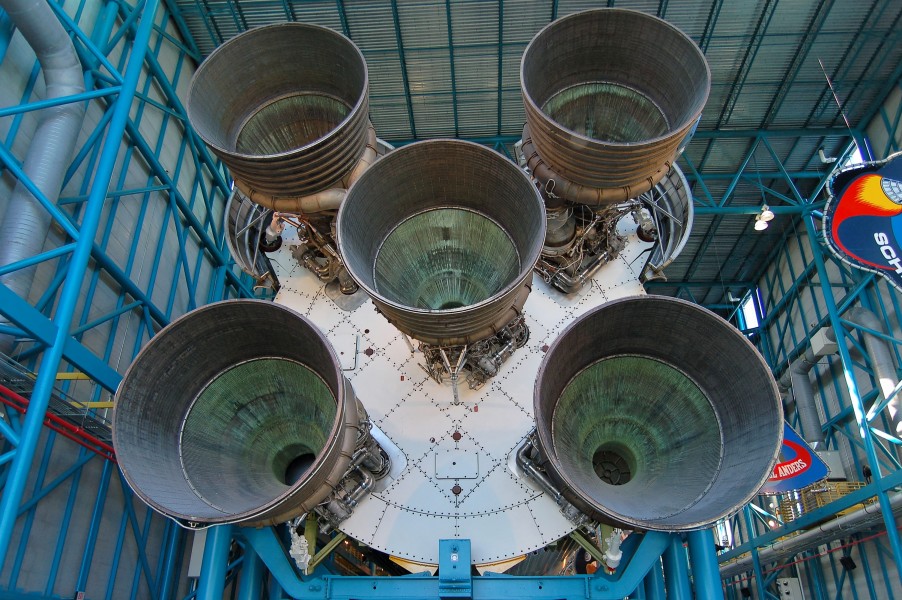
Upgraded photo of Saturn V Rocket. Same res', but better color, clarity
One of the newest pieces of hardware docked with the International Space Station is the Mini Research Module 2 (MRM-2), featured in this electronic still image downlinked by the Expedition 21 crewmembers during flight day six activities.
The Soyuz TMA-13 spacecraft is transported by rail car to its launch pad at the Baikonur Cosmodrome in Kazakhstan, Oct. 10, 2008 for launch Oct. 12 to carry NASA astronaut Michael Fincke, Expedition 18 commander; Russian Federal Space Agency cosmonaut Yury Lonchakov, Soyuz commander and Expedition 18 flight engineer; and American spaceflight participant Richard Garriott to the International Space Station. The three crew members will dock their Soyuz to the International Space Station on Oct. 14. Fincke and Lonchakov will spend six months on the station, while Garriott will return to Earth Oct. 24 with two of the Expedition 17 crewmembers currently on the station.
Gamma 8 rocket engine, used for the first stage of the Black Arrow launch vehicle. On display at the Science Museum, London
Gamma 2 rocket engine, used for the second stage of the Black Arrow launch vehicle. On display at the Science Museum, London
A Gamma 2 engine, as used on the second stage of the British BLACK ARROW rocket, at the National Space Centre, Leicester.
This image features a view of Space Shuttle Discovery docked to the Pressurized Mating Adapter 2 (PMA-2) on the Destiny laboratory of the international space station. The Crew Equipment Translation Aid (CETA) cart and the Mobile Base System (MBS), mounted on the S0 truss, are visible at left. Part of the P1 truss is also visible in the background. Dwarfed by the station and shuttle, Japan Aerospace Exploration Agency (JAXA) astronaut Soichi Noguchi, STS-114 mission specialist, is visible near the PMA-2 during the mission’s third session of extravehicular activity (EVA). The blackness of space and a blue and white Earth form the backdrop for the image.
This artist's concept of a lunar base and extra-base activity was revealed during a 1986 Summer Study on possible future activities for the National Aeronautics and Space Administration. A roving vehicle similar to the one used on three Apollo missions is depicted in the foreground.
The propulsion compartment of the Poisk Mini-Research Module 2 (MRM2) departs from the International Space Station and was deorbited four hours later for a destructive reentry in Earth's atmosphere. The undocking occurred at 6:16 p.m. (CST) on Dec. 7, 2009. Its departure opens up a docking port for Russian vehicles on Poisk, which will first be used when NASA astronaut Jeffrey Williams, Expedition 22 commander; and Russian cosmonaut Maxim Suraev, flight engineer, relocate their Soyuz spacecraft in January 2010.
apollo15lrv.jpg
Backdropped by Earth's horizon and the blackness of space, the new unpiloted Russian Mini-Research Module 2 (MRM2), also known as Poisk, approaches the International Space Station. The MRM2 docked to the space-facing port of the Zvezda Service Module at 9:41 a.m. (CST) on Nov. 12, 2009. It began its trip to the station when it was launched aboard a Soyuz rocket from the Baikonur Cosmodrome in Kazakhstan on Nov. 10. Poisk is a Russian term that translates to search, seek and explore. It will provide an additional docking port for visiting Russian spacecrafts and will serve as an extra airlock for spacewalkers wearing Russian Orlan spacesuits. Poisk joins a Russian Progress resupply vehicle and two Russian Soyuz spacecraft currently docked at the station.
John W. Young (Apollo 16)
Russian Federal Space Agency cosmonauts Sergei Volkov (bottom), Expedition 17 commander, and Oleg Kononenko, flight engineer, take a moment for a photo in the Jules Verne Automated Transfer Vehicle (ATV) while it remains docked with the International Space Station.
Astronaut James B. Irwin, Lunar Module pilot, works at the Lunar Roving Vehicle during the first Apollo 15 lunar surface extravehicular activity (EVA-1) at the Hadley-Apennine landing site. The shadow of the Lunar Module
Apollo 15 Lunar Module pilot James B. Irwin loads-up the
lunar_rover.jpg
Apollo 16 astronaut Charles M. Duke Jr., pilot of the Lunar Module
A view of the Russian space station Mir from the window of Space Shuttle Atlantis, showing the station's Kvant-2, Priroda, Spektr & Kristall modules and the docked Soyuz TM-26 capsule during STS-86.
space_shuttle_columbia_launching_edit.jpg
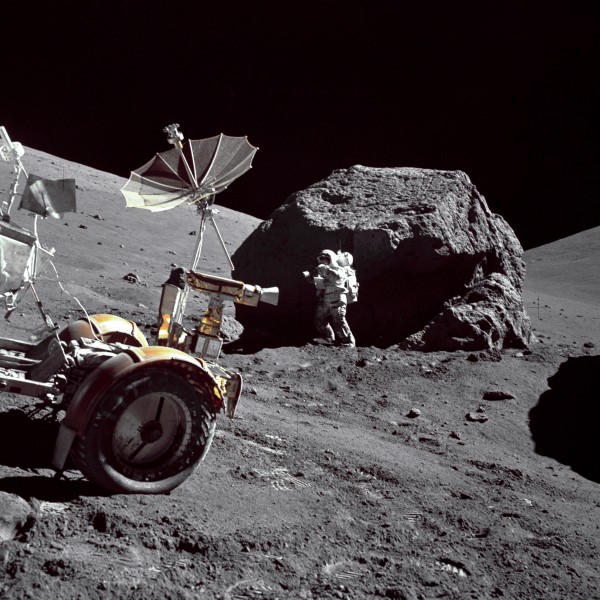
Astronaut Eugene A. Cernan, Apollo 17 mission commander, makes a short checkout of the Lunar Roving Vehicle during the early part of the first Apollo 17 extravehicular activity (EVA-1) at the Taurus-Littrow landing site. This view of the
Cropped version of Image:Apollo 15 Lunar Rover final resting place.jpg
One of a series of images taken as a pan of the Apollo 15 landing site, taken by Commander Dave Scott. Featured is the Lunar Roving Vehicle at it's final resting place after EVA-3. At the back is a rake used during the mission. Also note the red Bible atop the hand controller in the middle of the vehicle, placed there by Scott.
VANDENBERG AIR FORCE BASE, Calif. -- The Orbital Sciences Taurus XL rocket and NASA's encapsulated Glory spacecraft await launch on the pad at Vandenberg Air Force Base's Space Launch Complex 576-E in California. Liftoff originally was scheduled for 5:09 a.m. EST Feb. 23, but was scrubbed for at least 24 hours due to a technical issue that engineers are evaluating. Once Glory reaches orbit, it will collect data on the properties of aerosols and black carbon. It also will help scientists understand how the sun's irradiance affects Earth's climate. For information, visit www.nasa.gov/glory.
Russia's Mir space station taken from Space Shuttle STS-89 mission
BELOIT, Wis. (May 30, 2009) Crewmembers of the Blue Angels C-130 Hercules, Fat Albert, experience weightlessness during a flight demonstration at the Southern Wisconsin Airfest. The air show is in conjunction with Rock County Navy Week, one of 21 Navy Weeks planned across America in 2009. Navy Weeks are designed to show Americans the investment they have made in their Navy and increase awareness in cities that do not have a significant Navy presence. (U.S. Navy photo by Mass Communication Specialist 1st Class Mark O'Donald/Released)
vasimr-fr.jpg
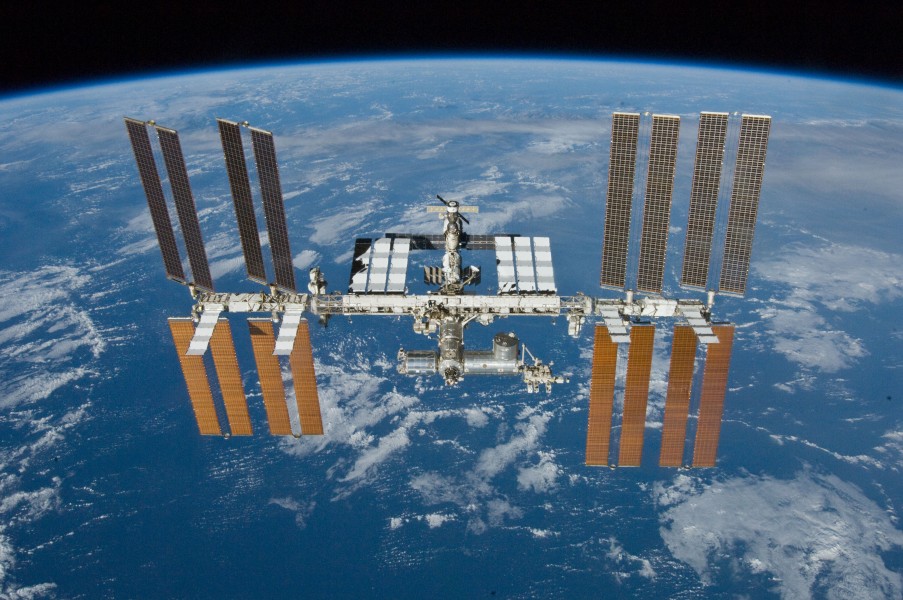
Backdropped by Earth's horizon and the blackness of space, the International Space Station is featured in this image photographed by an STS-130 crew member on space shuttle Endeavour after the station and shuttle began their post-undocking relative separation. Undocking of the two spacecraft occurred at 7:54 p.m. (EST) on Feb. 19, 2010.
A seven-year journey to the ringed planet Saturn begins with the liftoff of a Titan IVB/Centaur carrying the Cassini orbiter and its attached Huygens probe. Launch occurred at 4:43 a.m. EDT, Oct. 15, from Launch Complex 40 on Cape Canaveral Air Station. After a 2.2-billion mile journey that will include two swingbys of Venus and one of Earth to gain additional velocity, the two-story tall spacecraft will arrive at Saturn in July 2004. The orbiter will circle the planet for four years, its complement of 12 scientific instruments gathering data about Saturn's atmosphere, rings and magnetosphere and conducting closeup observations of the Saturnian moons. Huygens, with a separate suite of six science instruments, will separate from Cassini to fly on a ballistic trajectory toward Titan, the only celestial body besides Earth to have an atmosphere rich in nitrogen. Scientists are eager to study further this chemical similarity in hopes of learning more about the origins of our own planet Earth. Huygens will provide the first direct sampling of Titan's atmospheric chemistry and the first detailed photographs of its surface. The Cassini mission is an international effort involving NASA, the European Space Agency (ESA) and the Italian Space Agency, Agenzia Spaziale Italiana (ASI). The Jet Propulsion Laboratory manages the U.S. contribution to the mission for NASA's Office of Space Science. The major U.S. contractor is Lockheed Martin, which provided the launch vehicle and upper stage, spacecraft propulsion module and radioisotope thermoelectric generators that will provide power for the spacecraft. The Titan IV/Centaur is a U.S. Air Force launch vehicle, and launch operations were managed by the 45th Space Wing
Backdropped by a blue and white part of Earth, the International Space Station is featured in this image photographed by an STS-130 crew member on space shuttle Endeavour after the station and shuttle began their post-undocking relative separation. Undocking of the two spacecraft occurred at 7:54 p.m. (EST) on Feb. 19, 2010.
This picture of the Russian space station Mir over the Pacific Ocean was recorded by the Space Shuttle Discovery in February 1995. During this mission Discovery performed a rendezvous and
Backdropped by Earth's horizon and the blackness of space, the International Space Station is featured in this image photographed by an STS-130 crew member on space shuttle Endeavour after the station and shuttle began their post-undocking relative separation. Undocking of the two spacecraft occurred at 7:54 p.m. (EST) on Feb. 19, 2010.
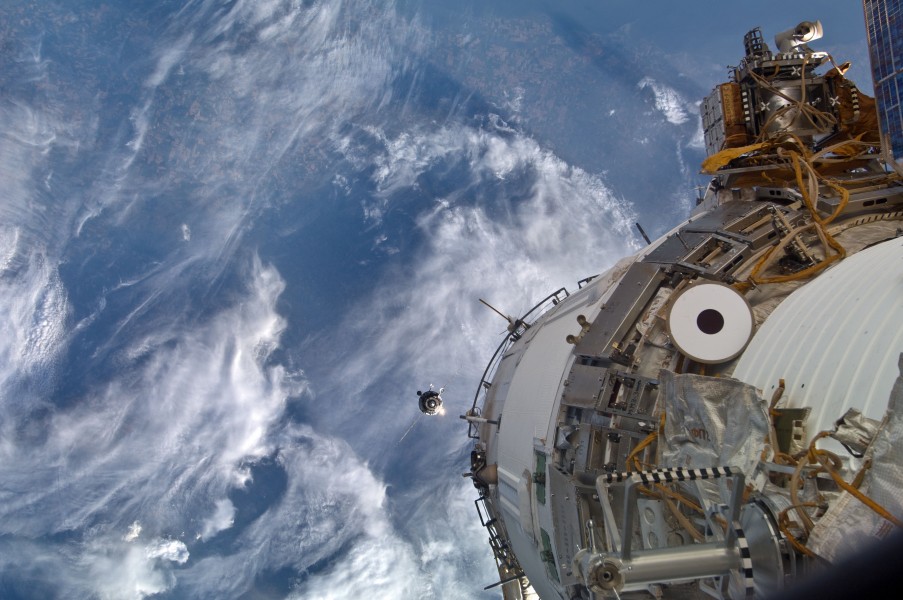
An unpiloted ISS Progress resupply vehicle approaches the International Space Station, bringing almost two tons of food, fuel, oxygen, propellant and supplies for the Expedition 24 crew members aboard the station. After an aborted docking on July 2, Progress 38 successfully docked to the aft end of the Zvezda Service Module at 12:17 p.m. (EDT) on July 4, 2010. The docking was executed flawlessly by Progress' Kurs automated rendezvous system.
Backdropped by a blue and white part of Earth, the International Space Station is featured in this image photographed by an STS-130 crew member on space shuttle Endeavour after the station and shuttle began their post-undocking relative separation. Undocking of the two spacecraft occurred at 7:54 p.m. (EST) on Feb. 19, 2010.
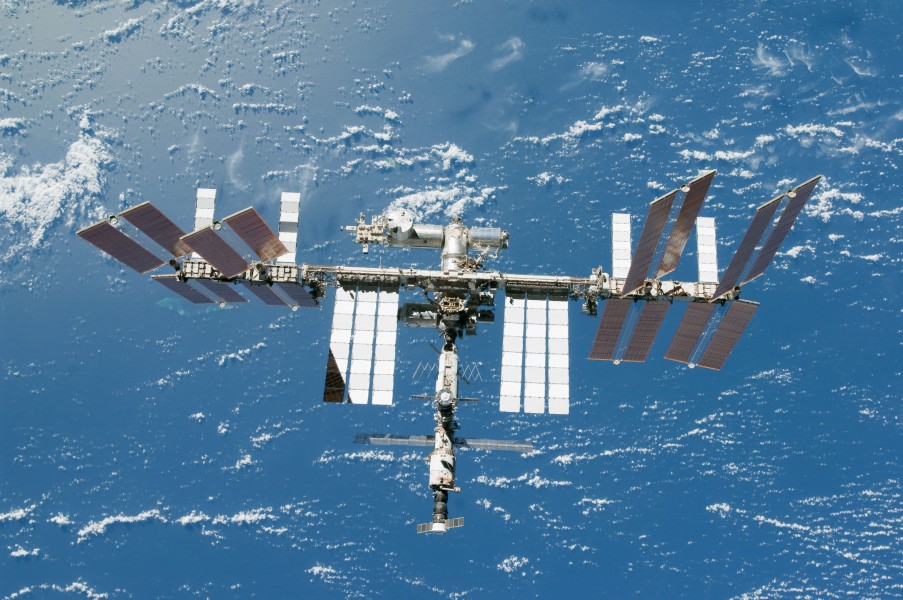
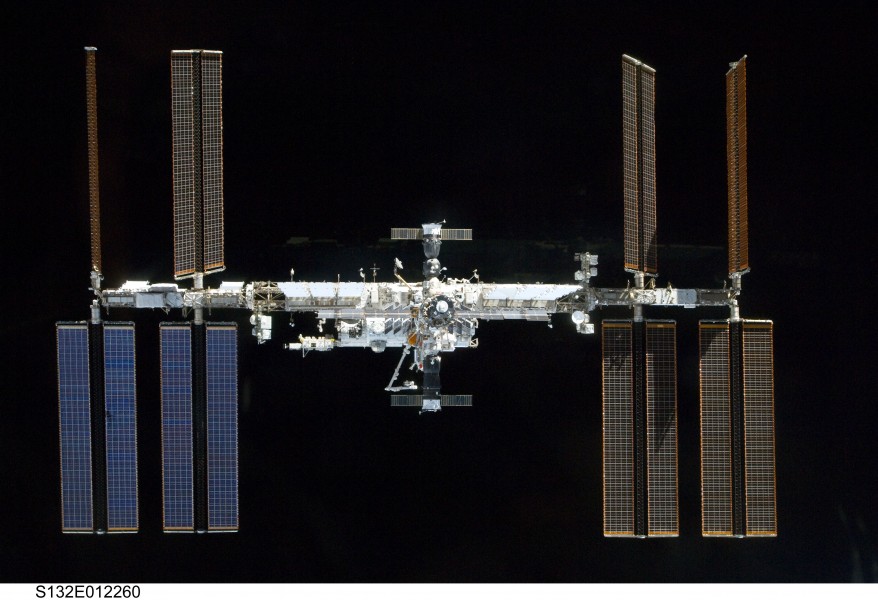
The International Space Station is featured in this image photographed by an STS-132 crew member on space shuttle Atlantis after the station and shuttle began their post-undocking relative separation. Undocking of the two spacecraft occurred at 10:22 a.m. (CDT) on May 23, 2010, ending a seven-day stay that saw the addition of a new station module, replacement of batteries and resupply of the orbiting outpost.
A Soyuz spacecraft, which carried the Soyuz 5 taxi crew, is docked to the Pirs docking compartment on the International Space Station (ISS). The new Soyuz TMA-1 vehicle was designed to accommodate larger or smaller crewmembers, and is equipped with upgraded computers, a new cockpit control panel and improved avionics. The blackness of space and Earth’s horizon provide the backdrop for the scene.
The Soyuz TMA-13 spacecraft arrives at the launch pad at the Baikonur Cosmodrome in Kazakhstan, Oct. 10, 2008 for launch Oct. 12 to carry NASA astronaut Michael Fincke, Expedition 18 commander; Russian Federal Space Agency cosmonaut Yury Lonchakov, Soyuz commander and Expedition 18 flight engineer; and American spaceflight participant Richard Garriott to the International Space Station. The three crew members will dock their Soyuz to the International Space Station on Oct. 14. Fincke and Lonchakov will spend six months on the station, while Garriott will return to Earth Oct. 24 with two of the Expedition 17 crewmembers currently on the station.
The International Space Station is featured in this image photographed by an STS-132 crew member on space shuttle Atlantis after the station and shuttle began their post-undocking relative separation. Undocking of the two spacecraft occurred at 10:22 a.m. (CDT) on May 23, 2010, ending a seven-day stay that saw the addition of a new station module, replacement of batteries and resupply of the orbiting outpost.
S132-E-008114 (18 May 2010) --- In the grasp of the Canadarm2, the Russian-built Mini-Research Module 1 (MRM-1) is transferred from space shuttle Atlantis' payload bay to be permanently attached to the Earth-facing port of the Zarya Functional Cargo Block (FGB) of the International Space Station. Named Rassvet, Russian for
View of the International Space Station from the departing Space Shuttle on mission STS-100.
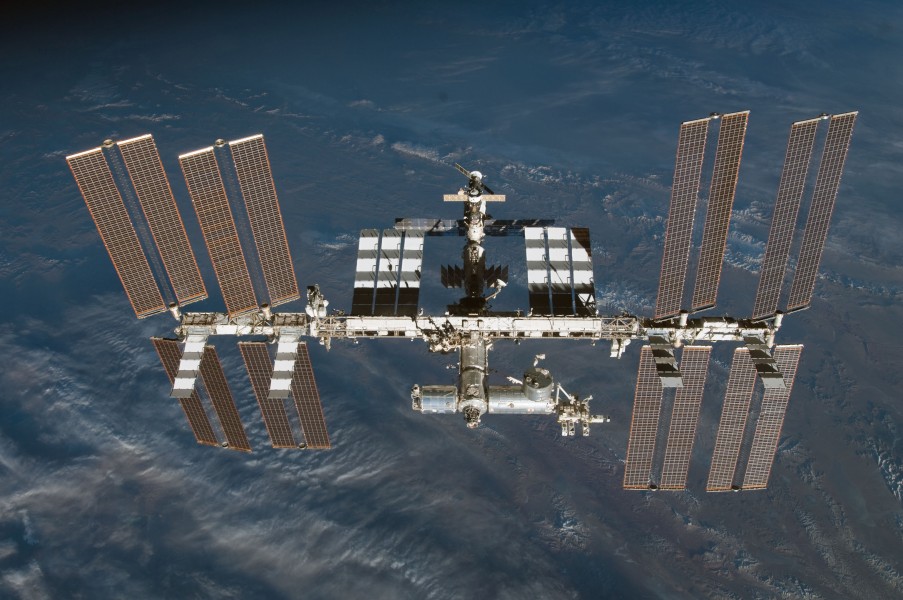
Backdropped by a blue and white Earth, the International Space Station is seen in this image taken by a crew member on the Space Shuttle Endeavour during STS-130, after the station and shuttle began their post-undocking relative separation. Undocking of the two spacecraft occurred at 19:54 EST on 19 February 2010. The two newest modules to be added to the station, Tranquillity and the Cupola, can be seen nestled beneath the Integrated Truss Structure, docked to Unity.
The International Space Station is featured in this image photographed by an STS-132 crew member on space shuttle Atlantis after the station and shuttle began their post-undocking relative separation. Undocking of the two spacecraft occurred at 10:22 a.m. (CDT) on May 23, 2010, ending a seven-day stay that saw the addition of a new station module, replacement of batteries and resupply of the orbiting outpost.
Backdropped by Earth's horizon and the blackness of space, the International Space Station is featured in this image photographed by an STS-131 crew member on space shuttle Discovery after the station and shuttle began their post-undocking relative separation. Undocking of the two spacecraft occurred at 7:52 a.m. (CDT) on April 17, 2010.
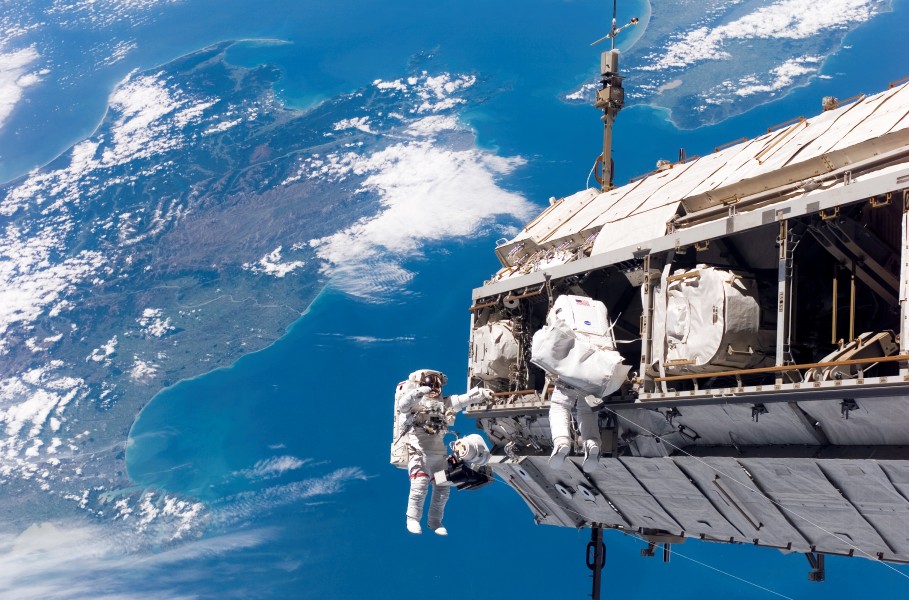
Original Description: ISS014-E-10084 (18 Dec. 2006) --- Astronaut Robert L. Curbeam Jr., STS-116 mission specialist, works with the port overhead solar array wing on the International Space Station's P6 truss during the mission's fourth session of extravehicular activity (EVA). European Space Agency (ESA) astronaut Christer Fuglesang (out of frame), mission specialist, worked in tandem with Curbeam, using specially prepared, tape-insulated tools, to guide the array wing neatly inside its blanket box during the 6-hour, 38-minute spacewalk.
Backdropped by Earth's horizon and the blackness of space, the International Space Station is featured in this image photographed by an STS-130 crew member on space shuttle Endeavour after the station and shuttle began their post-undocking relative separation. Undocking of the two spacecraft occurred at 7:54 p.m. (EST) on Feb. 19, 2010.
An artist’s conception of the autonomous Demonstration for Autonomous Rendezvous (DART) spacecraft as it approaches the Multiple Paths, Beyond-Line-of-Site Communications (MUBLCOM) satellite. NASA is testing the DART as a docking system for next generation vehicles to guide spacecraft carrying cargo or equipment to the International Space Station, or retrieving or servicing satellites in orbit. Before the new system can be implemented on piloted spacecraft, it has to be tested in space. The computer-guided DART is equipped with an Advanced Video Guidance Sensor and a Global Positioning System that can receive signals from other spacecraft to allow DART to move within 330 feet of the target. DART is scheduled to launch from Vandenberg Air Force Base in California no earlier than Oct. 18. It will be released from a Pegasus XL launch vehicle carried aloft by an Orbital Sciences Corporation aircraft. The fourth stage of the Pegasus rocket will remain attached as an integral part of the spacecraft, allowing it to maneuver in space. Once in orbit, DART will race toward the target, the MUBLCOM satellite, for a rendezvous.
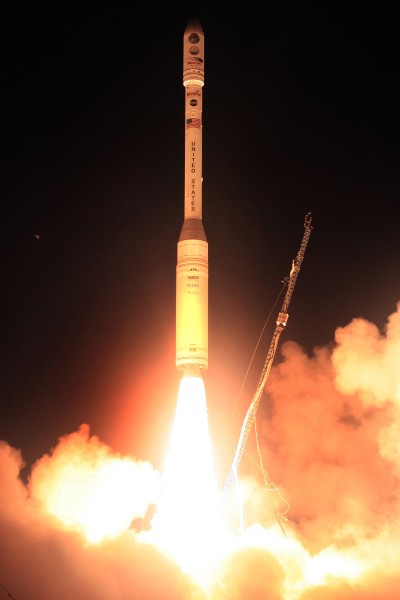
NASA’s Orbiting Carbon Observatory and its Taurus booster lift off Feb. 24 from Vandenberg Air Force Base in California at 4:55 a.m. EST. A contingency was declared a few minutes later and the satellite failed to reach orbit after liftoff. Preliminary indications are that the fairing on the Taurus XL launch vehicle failed to separate. The fairing is a clamshell structure that encapsulates the satellite as it travels through the atmosphere. A Mishap Investigation Board is being set up to determine the cause of the launch failure.
Diagram of the Cassini Spacecraft - German
iss-celestia.jpg
This McDonnell-Douglas concept drawing depicts a robotic arm controlled by an astronaut. The arm is being used to maneuver anew addition to the space station into place. The robotic arm was to have been essential to building the space station in orbit.
The Space Shuttle Endeavor crew captured this shot of the International Space Station (ISS) against the backdrop of Planet Earth. Pictured here the ISS is visible in front the Ionian Sea. The boot of Italy is visible on the left, while the western coastlines of Greece and Albania stretch across the top. The dorsal fin of the upside-down shuttle orbiter pokes into the very top of the image.
This illustration is an orbiter cutaway view with callouts. The orbiter is both the brains and heart of the Space Transportation System (STS). About the same size and weight as a DC-9 aircraft, the orbiter contains the pressurized crew compartment (which can normally carry up to seven crew members), the huge cargo bay, and the three main engines mounted on its aft end. There are three levels to the crew cabin. Uppermost is the flight deck where the commander and the pilot control the mission. The middeck is where the gallery, toilet, sleep stations, and storage and experiment lockers are found for the basic needs of weightless daily living. Also located in the middeck is the airlock hatch into the cargo bay and space beyond. It is through this hatch and airlock that astronauts go to don their spacesuits and manned maneuvering units in preparation for extravehicular activities, more popularly known as spacewalks. The Space Shuttle's cargo bay is adaptable to hundreds of tasks. Large enough to accommodate a tour bus (60 x 15 feet or 18.3 x 4.6 meters), the cargo bay carries satellites, spacecraft, and spacelab scientific laboratories to and from Earth orbit. It is also a work station for astronauts to repair satellites, a foundation from which to erect space structures, and a hold for retrieved satellites to be returned to Earth. Thermal tile insulation and blankets (also known as the thermal protection system or TPS) cover the underbelly, bottom of the wings, and other heat-bearing surfaces of the orbiter to protect it during its fiery reentry into the Earth's atmosphere. The Shuttle's 24,000 individual tiles are made primarily of pure-sand silicate fibers, mixed with a ceramic binder. The solid rocket boosters (SRB's) are designed as an in-house Marshall Space Flight Center project, with United Space Boosters as the assembly and refurbishment contractor. The solid rocket motor (SRM) is provided by the Morton Thiokol Corporation.
This image is an artist's concept of the Skylab in orbit.
Astronaut Joseph Acaba operated Discovery's robotic arm after the shuttle reaches space.
Panorama of Hadley Delta with Lunar Module and Lunar Roving Vehicle, Picture AS15-82-11048HR to AS15-82-11063HR
The Progress M-05M cargo spacecraft.
This artist's concept shows how CALIPSO and CloudSat will fly in formation with other Earth Observing Satellites
View of the Flight Control Room at Russia’s Federal Space Agency Mission Control Center in Korolev, Russia, located on the outskirts of Moscow.
This illustration is an orbiter cutaway view with callouts. The orbiter is both the brains and heart of the Space Transportation System (STS). About the same size and weight as a DC-9 aircraft, the orbiter contains the pressurized crew compartment (which can normally carry up to seven crew members), the huge cargo bay, and the three main engines mounted on its aft end. There are three levels to the crew cabin. Uppermost is the flight deck where the commander and the pilot control the mission. The middeck is where the gallery, toilet, sleep stations, and storage and experiment lockers are found for the basic needs of weightless daily living. Also located in the middeck is the airlock hatch into the cargo bay and space beyond. It is through this hatch and airlock that astronauts go to don their spacesuits and manned maneuvering units in preparation for extravehicular activities, more popularly known as spacewalks. The Space Shuttle's cargo bay is adaptable to hundreds of tasks. Large enough to accommodate a tour bus (60 x 15 feet or 18.3 x 4.6 meters), the cargo bay carries satellites, spacecraft, and spacelab scientific laboratories to and from Earth orbit. It is also a work station for astronauts to repair satellites, a foundation from which to erect space structures, and a hold for retrieved satellites to be returned to Earth. Thermal tile insulation and blankets (also known as the thermal protection system or TPS) cover the underbelly, bottom of the wings, and other heat-bearing surfaces of the orbiter to protect it during its fiery reentry into the Earth's atmosphere. The Shuttle's 24,000 individual tiles are made primarily of pure-sand silicate fibers, mixed with a ceramic binder. The solid rocket boosters (SRB's) are designed as an in-house Marshall Space Flight Center project, with United Space Boosters as the assembly and refurbishment contractor. The solid rocket motor (SRM) is provided by the Morton Thiokol Corporation.
In the grasp of the station's robotic Canadarm2, the Russian-built Mini-Research Module 1 (MRM-1) is attached to the Earth-facing port of the Zarya Functional Cargo Block (FGB) of the International Space Station. Named Rassvet, Russian for
Launch of the TAOS satellite.
A partial view of the space shuttle Atlantis (STS-129), docked to the International Space Station, along with the station's Canadarm2, the Columbus laboratory and Harmony node are featured in this image photographed by a space-walking astronaut during the mission's third and final spacewalk.
The unpiloted ISS Progress 38 resupply vehicle approaches the International Space Station, bringing almost two tons of food, fuel, oxygen, propellant and supplies for the Expedition 24 crew members aboard the station. The attempted docking on July 2, 2010, was aborted when telemetry between the Progress and the space station was lost about 25 minutes before its planned docking. As a result, the Progress vehicle continued on its trajectory and glided past the space station. Later, the Progress successfully docked to the aft end of the Zvezda Service Module at 12:17 p.m. (EDT) on July 4, 2010. The docking was executed flawlessly by Progress' Kurs automated rendezvous system.
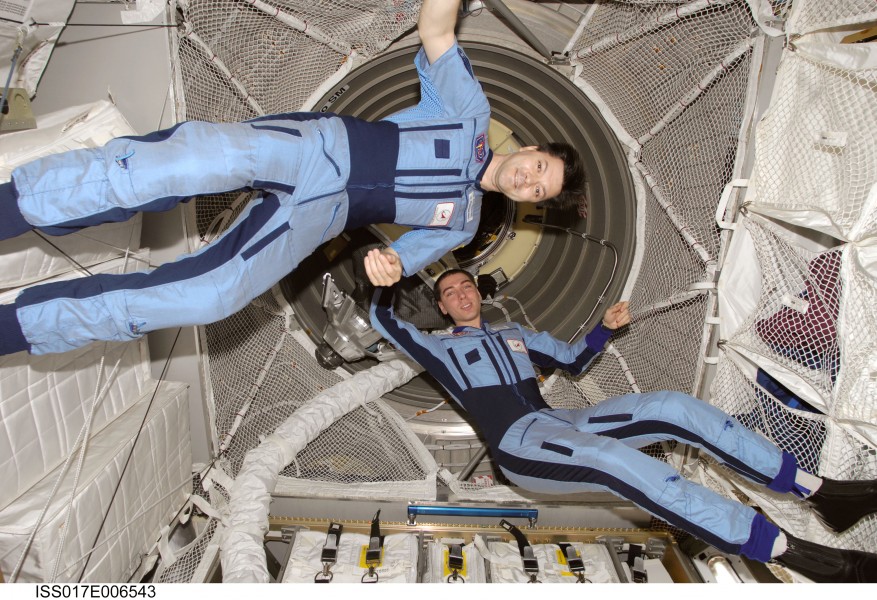
Onboard the International Space Station, European Space Agency astronauts Paolo Nespoli (left) and Roberto Vittori shake hands following an Earth-to-space phone tag-up with Italian President Giorgio Napolitano. Nespoli has been on the station for over five months and is due to return to Earth in less than 24 hours. Vittori is on a 16-day mission of the space shuttle Endeavour, joined by five NASA astronauts. This occasion is the second time two Italian astronauts have been in space together and the first time in the last 15 years.
Backdropped by Earth's horizon and the blackness of space, an unpiloted ISS Progress resupply vehicle approaches the International Space Station, bringing about 2 ВЅ tons of food, fuel, oxygen, propellant and supplies for the Expedition 24 crew members aboard the station. Progress 39 successfully docked to the aft port of the Zvezda Service Module at 7:58 a.m. (EDT) on Sept. 12, 2010. The docking was executed flawlessly by the Kurs automated rendezvous system.
The Soyuz TMA-21 spacecraft is rolled out by train on its way to the launch pad at the Baikonur Cosmodrome in Kazakhstan, April 2, 2011. The launch of the Soyuz spacecraft is scheduled for April 5, 2011 (Kazakhstan time). Onboard will be NASA astronaut Ron Garan, flight engineer; Russian cosmonaut Alexander Samokutyaev, Soyuz commander; and Russian cosmonaut Andrey Borisenko, flight engineer.
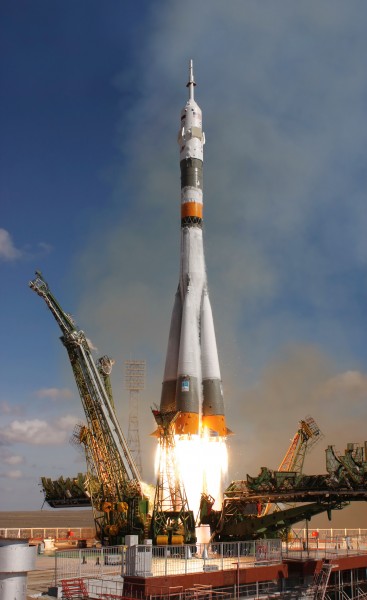
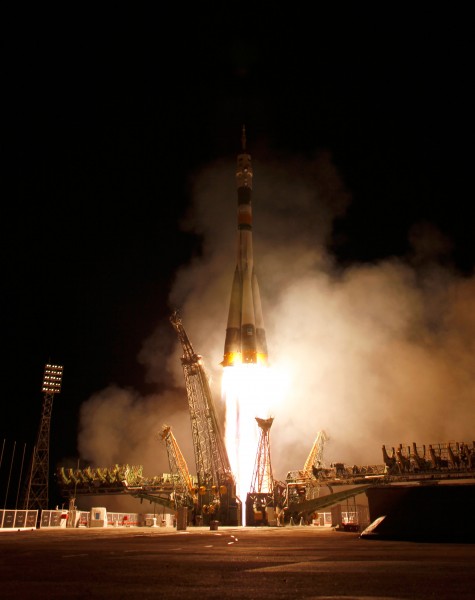
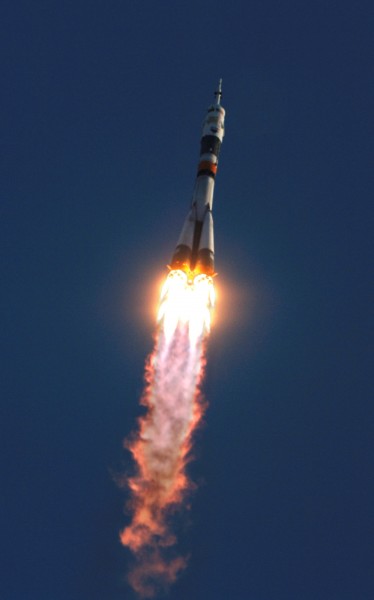
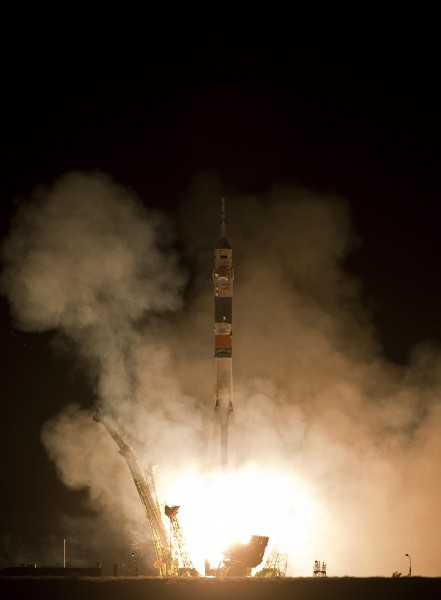
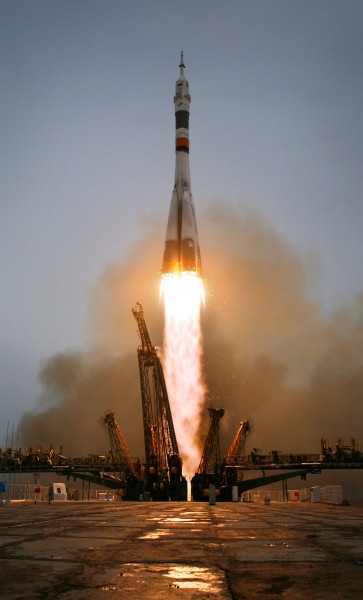
The Soyuz TMA-21 launches from the Baikonur Cosmodrome in Kazakhstan on April 5, 2011 (Kazakhstan time) carrying three Expedition 27 crew members on their to join the rest of the crew already onboard the International Space Station. The three are Russian cosmonaut and Soyuz commander Alexander Samokutyaev, and NASA astronaut Ron Garan and Russian cosmonaut Andrey Borisenko, both flight engineers. The Soyuz, which has been dubbed
Black Knight tail showing motors at World Museum Liverpool
A media event was hosted by NASA and the Russian Federal Space Agency, Roscosmos, to showcase the Russian-built Mini-Research Module-1, or MRM-1, in the Astrotech payload processing facility at Port Canaveral, Fla. Technicians continue to process and inspect the MRM-1 during the event. The six-member crew of space shuttle Atlantis' STS-132 mission will deliver an Integrated Cargo Carrier and the MRM-1, known as Rassvet, to the International Space Station. The second in a series of new pressurized components for Russia, MRM-1 will be permanently attached to the Earth-facing port of the Zarya control module. Rassvet, which translates to
Backdropped by a blue and white Earth, the Space Shuttle Atlantis approaches the International Space Station during STS-117 rendezvous and docking operations. Docking occurred at 2:36 p.m. (CDT) on June 10, 2007. A pair of solar arrays and starboard truss segments (S3/S4), which are later to be attached to the station and outfitted during three spacewalks, can be seen in Atlantis' cargo bay. A docked Soyuz spacecraft is visible at top center.
The Russian segment of the International Space Station is featured in this image photographed by a space-walking astronaut during the third and final spacewalk for the STS-129 mission. The Poisk Mini Research Module 2 (MRM2), docked to the space-facing port of the Zvezda Service Module, is at top center; and a Progress resupply vehicle is docked to the Pirs Docking Compartment at bottom center. Zarya (partially obscured by solar panels) is at right center. Earth's horizon and the blackness of space provide the backdrop for the scene.
NASA astronauts Nicole Stott and Michael Barratt, both STS-133 mission specialists, are pictured in the European Space Agency's
An overhead view of the Skylab Orbital Workshop in Earth orbit as photographed from the Skylab 4 Command and Service Modules (CSM) during the final fly-around by the CSM before returning home. The space station is contrasted against the pale blue Earth. During launch on May 14, 1973, some 63 seconds into flight, the micrometeor shield on the Orbital Workshop (OWS) experienced a failure that caused it to be caught up in the supersonic air flow during ascent. This ripped the shield from the OWS and damaged the tie downs that secured one of the solar array systems. Complete loss of one of the solar arrays happened at 593 seconds when the exhaust plume from the S-II's separation rockets impacted the partially deployed solar array system. Without the micrometeoroid shield that was to protect against solar heating as well, temperatures inside the OWS rose to 126 degrees fahrenheit. The gold
In Orbiter Processing Facility-1 at NASA's Kennedy Space Center in Florida, space shuttle main engine #2 is nearly in position for installation on space shuttle Atlantis for its upcoming STS-132 mission. A main engine is 14 feet long, weighs approximately 7,000 pounds, and is 7.5 feet in diameter at the end of the nozzle. Inspection and maintenance of each of the shuttle's three main engines are an important safety measure and standard procedure between shuttle missions. Atlantis is scheduled to deliver an Integrated Cargo Carrier and Russian-built Mini Research Module to the International Space Station on STS-132. The second in a series of new pressurized components for Russia, the module will be permanently attached to the Zarya module. Three spacewalks are planned to store spare components outside the station, including six spare batteries, a boom assembly for the Ku-band antenna and spares for the Canadian Dextre robotic arm extension. A radiator, airlock and European robotic arm for the Russian Multi-purpose Laboratory Module also are payloads on the flight. Launch is targeted for May 14
Russian Federal Space Agency cosmonauts Sergei Volkov (left) and Oleg Kononenko, Expedition 17 commander and flight engineer, respectively, make preparations in the International Space Station's Zvezda Service Module for the undocking of the European Space Agency's (ESA)
The Soyuz TMA-20 spacecraft arrives at the launch pad Dec. 13, 2010 at the Baikonur Cosmodrome in Kazakhstan. The Soyuz is scheduled to launch the crew of Expedition 26 on Dec. 16, 2010 (Kazakhstan time).
Dual-keel design (1986), Space Station Freedom
The Soyuz TMA-21 spacecraft is lifted into position on the launch pad at the Baikonur Cosmodrome in Kazakhstan, April 2, 2011. The Soyuz, which has been dubbed
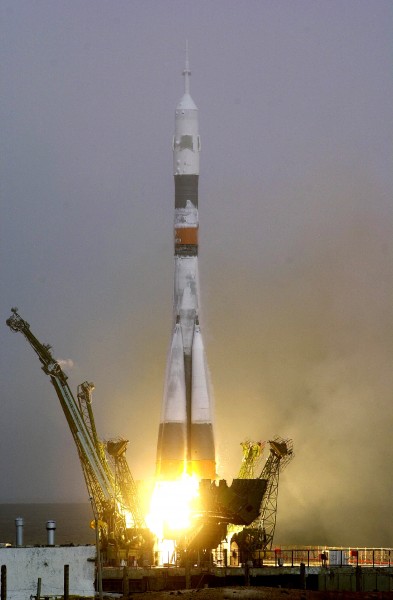
A Soyuz rocket launches from the Baikonur Cosmodrome, Kazakhstan with Expedition 12 Commander William S. McArthur, Jr., Flight Engineer and Soyuz Commander Valery I. Tokarev and U.S. Spaceflight Participant Gregory Olsen aboard. The trio is on a mission to the international space station lasting six months for McArthur and Tokarev. Olsen will return after ten days in space under a commercial contract with the Russian Federal Space Agency.
Launch of a multistage model rocket.
Cropped image
STS-116 Shuttle Mission Imagery
S116-E-06753 (17 Dec. 2006) --- The docked Soyuz 13 (TMA-9) (foreground) and Progress 22 resupply vehicle are featured in this image photographed by a STS-116 crewmember from a window on the International Space Station while Space Shuttle Discovery was docked with the station. The blackness of space and Earth's horizon provide the backdrop for the scene.
Progress M1-7 seen from the International Space Station during docking.
European Space Agency's ESOC main control room in Darmstadt, Germany. Detail.
The main control room of the European Space Operations Centre in Darmstadt, Germany.
European Space Agency's ESOC main control room in Darmstadt, Germany. Seen from the visitors room.
Progress M1-11 seen from the International Space Station during docking.
This three-radial-module space station concept was intended to utilize Apollo hardware to deploy the station and to transfer crews to and from orbit.
Cropped image of Progress M1-11 seen from the International Space Station during docking.
Progress M-62 seen from the International Space Station whilst docked.
progress_m-48_2.jpg
A Metop spacecraft ready for the launch atop a Soyuz-2.1a rocket.
Photo of a model of the Prospero X-3 satellite in London's Science Museum.
calipso_-_artist_concept.jpg
vostokpanel.jpg
Inside orbiter Atlantis at Kennedy Space Center, JoAnn H. Morgan, then Associate Director for Advanced Development and Shuttle Upgrades (standing second from left), with Director Roy Bridges (seated at bottom left), Laural Patrick (standing left), a systems engineer with MEDS, and George Selina (at right), with United Space Alliance.
en:Rocket Engines from the booster stage of the Saturn V rocket.
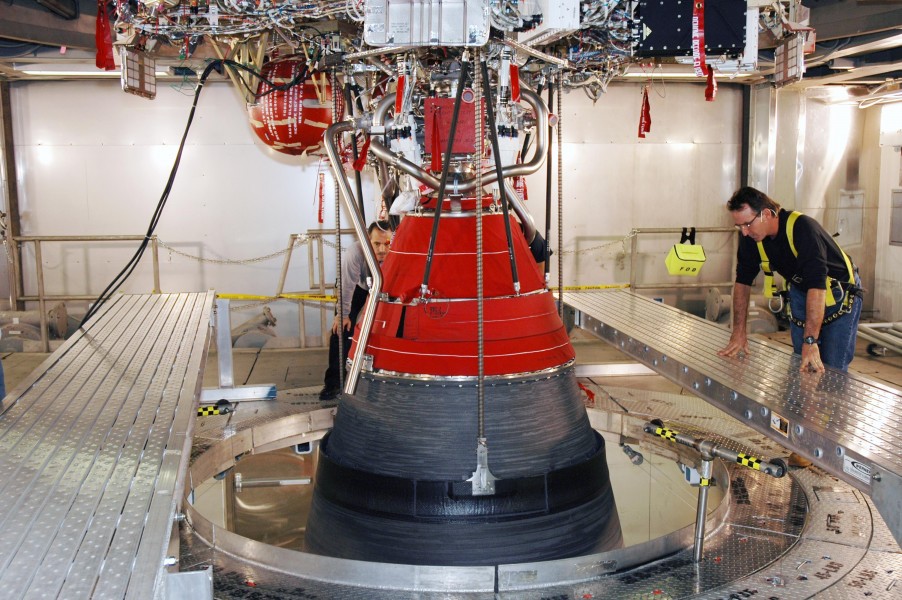
Image of a Delta IV second stage with an RL-10B-2 engine. NASA derived.
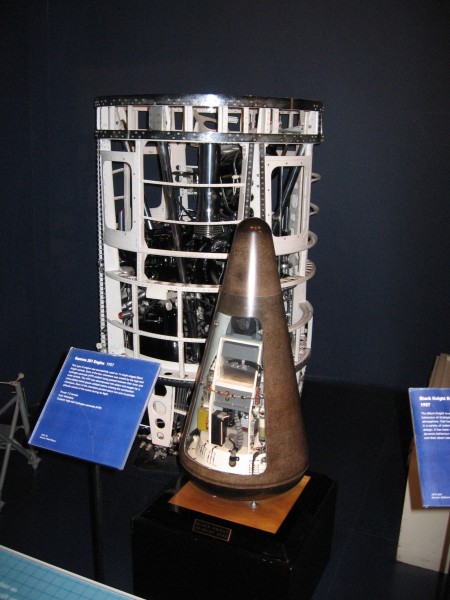
Gamma 201 engine and re-entry head of the Black Knight rocket at the Science Museum, London.
transhab-cutaway.jpg
saturnv_s-ivb.jpg
saturnv_s-ii.jpg
saturnv_s-ic.jpg
saturn_ib_second_stage_cutaway.jpg
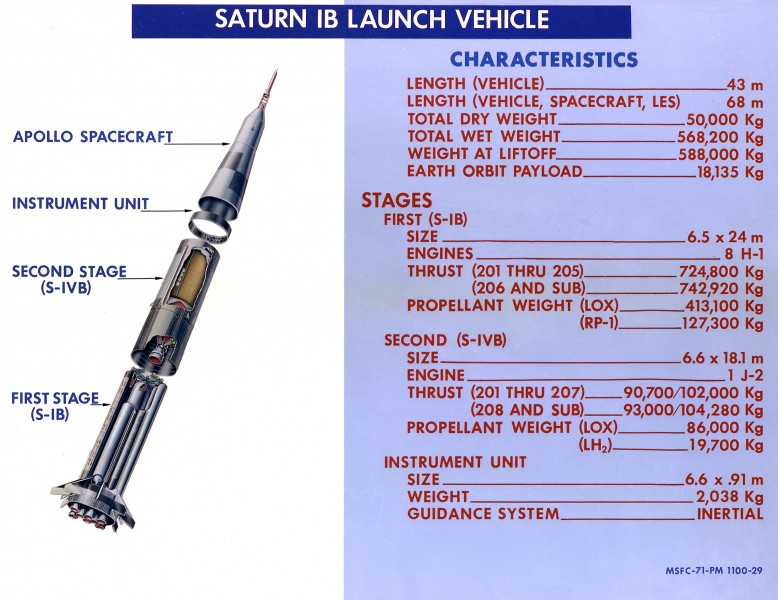
Saturn IB configuration. The Saturn IB and Saturn V carried a 21.7 foot diameter Instrument Unit manufactured by IBM. [http://mix.msfc.nasa.gov/IMAGES/HIGH/0100801.jpg
This is a concept drawing of an orbit and launch facility. Itwas to use a nuclear SNAP-II nuclear power supply on the end of the long telescoping boom. Nuclear reactors were considereddangerous, which is why in this concept drawing it was located sofar away from the habitat part of the station. Creators envisioned the structure being built in orbit to allow assembly of the station in orbit which could be then larger than anything that could be launched from Earth. The two main modules were to be 33 feet in diameter and 40 feet in length. When combined themodules would create a four deck facility, 2 decks to be used forlaboratory space and 2 decks for operations and living quarters.The facility also allowed for servicing and launch of a spacevehicle. Though the station was designed to operate in micro-gravity, it would also have an artificial gravity capability.
Orbital Maneuvering System's engines - spaceshuttle
091013-N-2442S-001 PATUXENT RIVER, MD (Oct. 13, 2009) An F404 engine from an F/A-18 runs on biofuel in a Naval Air Systems Command test at the Aircraft Test and Evaluation Facility, Patuxent River, MD.
Artist representation of CERES instruments scan Earth in RAP Rotating Azimuth Plane mode.
airsar-instrument-on-aircraft.jpg
NERVA Nuclear Rocket Engine.
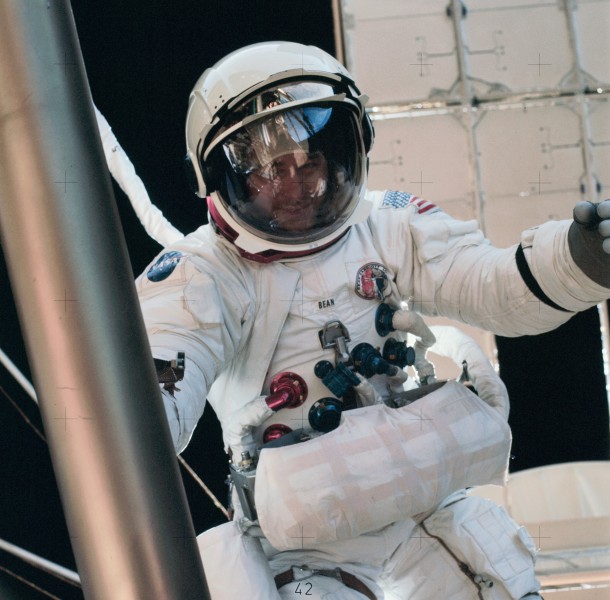
Astronaut Alan L. Bean, Skylab 3 commander, participates in the final Skylab 3 extravehicular activity, during which a variety of tasks were performed. Here, Bean is near the Apollo Telescope Mount (ATM) during final film change out for the giant telescope facility. Astronaut Owen K. Garriott, who took the picture, is reflected in Bean's helmet visor. The reflected Earth disk in Bean's visor is so clear that the Red Sea and Nile River area can delineated. Original was labeled CX-27. Camera Data: 70mm Hasselblad; Lens 100mm; Film Type: S0-368 Medium Speed Ektachrome.
Vandenberg Air Force Base, Calif. ??� Inside a protected clean room tent on Vandenberg Air Force Base in California, a worker (right) examines part of the second half of the fairing to be installed around NASA??�s Interstellar Boundary Explorer, or IBEX, spacecraft. The fairing is a molded structure that fits flush with the outside surface of the rocket and forms an aerodynamically smooth nose cone, protecting the spacecraft during launch and ascent. The IBEX satellite will make the first map of the boundary between the Solar System and interstellar space. IBEX is targeted for launch from the Kwajalein Atoll, a part of the Marshall Islands in the Pacific Ocean, on Oct. 19. IBEX will be launched aboard a Pegasus rocket dropped from under the wing of an L-1011 aircraft flying over the Pacific Ocean. The Pegasus will carry the spacecraft approximately 130 miles above Earth and place it in orbit. Photo credit: NASA/Randy Beaudoin, VAFB
Astronaut Peggy Whitson (right), Expedition 16 commander, greets astronaut Pam Melroy, STS-120 commander, after hatch opening between the International Space Station and Space Shuttle Discovery. Whitson is partially in the Pressurized Mating Adapter (PMA-2) and Melroy is in the Orbiter Docking Compartment (ODC).
In the Astrotech payload processing facility at Port Canaveral, Fla., preparations are under way to place the Russian-built Mini-Research Module-1, or MRM-1, into the transportation container in which it will be moved to the Space Station Processing Facility at NASA's Kennedy Space Center. The six-member crew of space shuttle Atlantis' STS-132 mission will deliver an Integrated Cargo Carrier and the MRM-1, known as Rassvet, to the International Space Station. The second in a series of new pressurized components for Russia, MRM-1 will be permanently attached to the Earth-facing port of the Zarya control module. Rassvet, which translates to
Astronaut Marc Garneau, with a camera in hand, floats in the hatchway that leads from Unity to Pressurized Mating Adapter-3 (PMA-3), which leads to Endeavour. Garneau, STS-97 mission specialist representing the Canadian Space Agency (CSA), and his four crew mates went into the International Space Station (ISS) following hatch opening. The photograph was taken with a digital still camera.
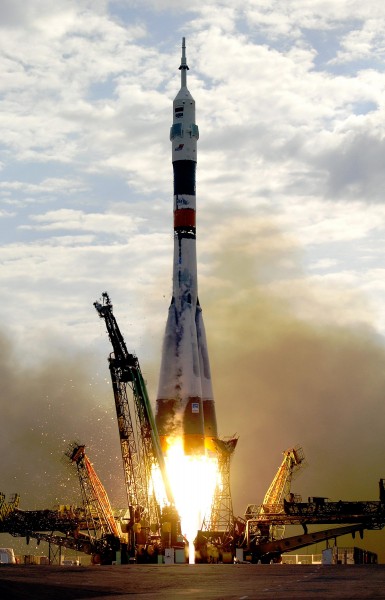
JSC2006-E-40672 (18 Sept. 2006) --- The Soyuz TMA-9 spacecraft launches from the Baikonur Cosmodrome in Kazakhstan Sept. 18, 2006 carrying a new crew to the International Space Station. The Soyuz lifted off at 10:09 a.m. Baikonur time with astronaut Michael E. Lopez-Alegria, Expedition 14 commander and NASA space station science officer; cosmonaut Mikhail Tyurin, Soyuz commander and flight engineer representing Russia's Federal Space Agency; and spaceflight participant Anousheh Ansari, who will spend nine days on the station under a commercial agreement with the Russian Federal Space Agency.
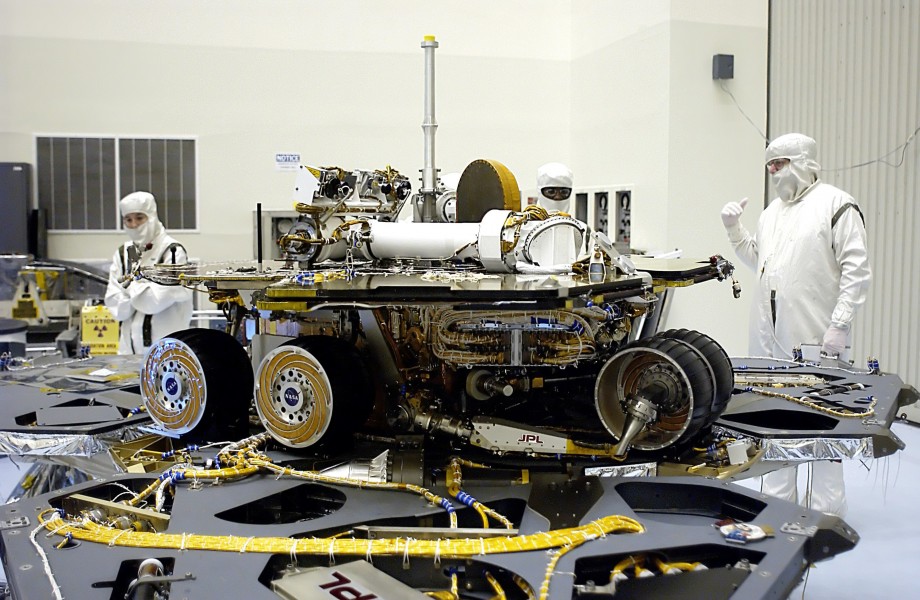
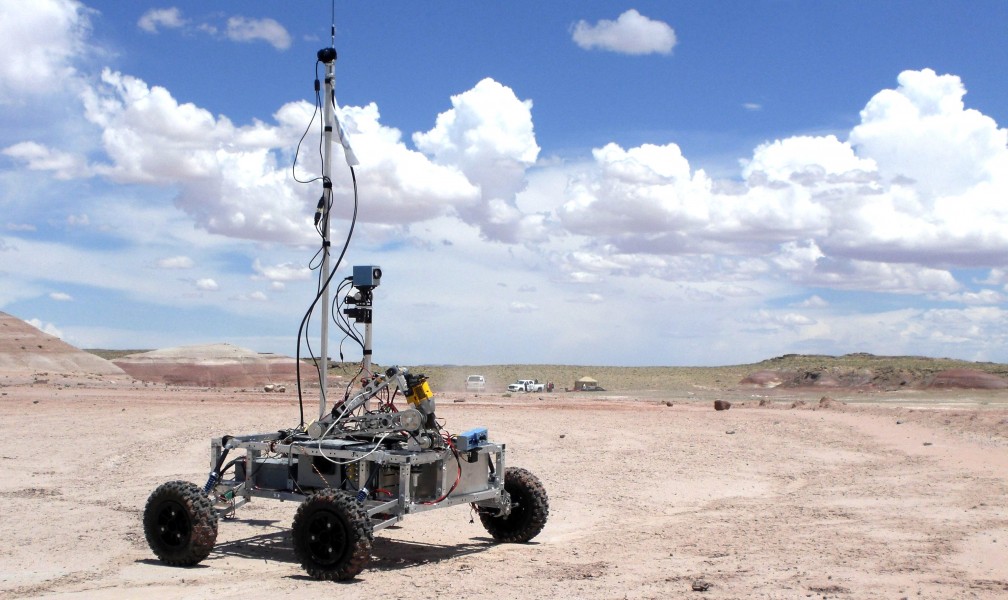
A Mars Rover robot simulated on MSRDS by SimplySim
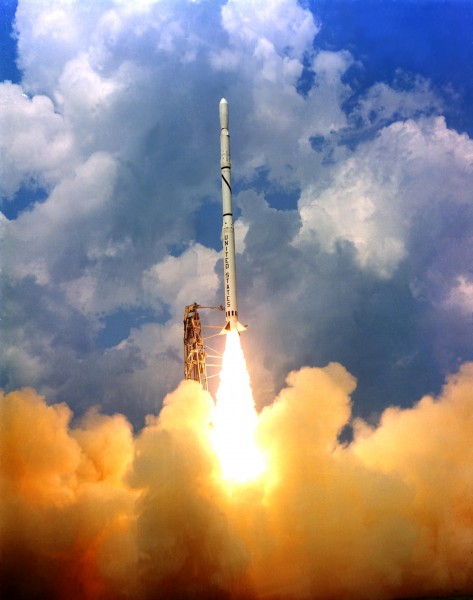
Able IV, the world's first space engine, was built as part of the Pioneer program. A launch attempt made on November 26, 1959, resulted in the loss of the spacecraft.
This image was downloaded from http://mix.msfc.nasa.gov/IMAGES/MEDIUM/9902050.jpg -
pla_nik_orbitera_2.jpg
Figure 3-5. Cutaway of TKS vehicle. Details are conjectural. The broad black line outlines the vehicle’s pressurized compartments. A tunnel (stippled) connects the FGB and Merkur capsule.
Figure 2-4. Partial cutaway of Proton configured for space station launch. The three-stage Proton rocket has launched all Soviet space stations and space station modules. Proton first flew as a two-stage vehicle in 1965. The threestage version used to launch stations debuted in 1969 and was declared operational in 1970. All three stages burn UDMH and N2O4 propellants. The three-stage Proton can place 20,000 kg in a circular 185 km orbit at 51.6В° of inclination.
Astronaut Jeffrey N. Williams, Expedition 13 NASA space station science officer and flight engineer, trims astronaut Thomas Reiter's hair in the Unity node of the International Space Station. Williams used hair clippers fashioned with a vacuum device to garner freshly cut hair. Reiter, flight engineer, represents the European Space Agency (ESA).
mirv_cut-away.jpg
cosmos-954_scheme.jpg
Image from the public domain book A Concise History of the U.S. Air Force by Stephen L. McFarland.
Marshall and Cal Poly technicians wired the NanoSail-D spacecraft to accelerometers, instruments which measure vibration response during simulated launch conditions.
Artist concept of NanoSail-D in space.
NanoSail-D deployment, part 3: Fully deployed, the sail area measures 107 ft2 (9.94 m2). It is comprised of four triangular membranes supported by thin metal tape booms. Full deployment takes just 5 seconds.
NanoSail-D deployment, part 2: The sail, made of extremely lightweight gossamer fabric manufactured by ManTech SRS of Huntsville, AL, begins to unfurl supported by rigid trac booms provided by the Air Force Research Laboratory. The sail material is much thinner than a piece of paper (less than 1/16th the thickness of a human hair) and coated with an extremely thin layer of aluminum to enhance its ability to reflect solar energy. Here on Earth, gravity prevents the doors from fully opening but in the microgravity of space, the doors will swing open freely. For this test, engineers used rubber bands to secure the doors in the open position.
A photo of the experimental solar sail, NanoSail-D.
zenit-2_rocket_ready_for_launch.jpg
zenit-2_rocket_erected.jpg
vanguard2_people.jpg
vanguard_tv-3_launchpad.jpg
The launch of SLV-1, which failed at second-stage burnout.
Vanguard rocket (U.S. Navy)
Launched by the U.S. Navy 1957-59
vanguard_rocket_on_launch_pad.jpg
TV-4 was launched 17 March 1958, pulling Vanguard I into orbit.
SLV-3 was launched 26 September 1958, from the new movable firing structure. The velocity of the third stage fell short of orbital velocity.
Rocket used for the launch of the Vanguard 1 satelite
White Sands Missile Range, V-2 Rocket Facilities, Near Headquarters Area, White Sands vicinity (Dona Ana County, New Mexico)(cropped)
truetrue
A V2 on display.
truetrue
truetrue
truetrue
V2 (A4) Rocketmotor
truetrue
truetrue
v2-pumpe.jpg
v2-ein_kreisel_der_steuerung.jpg
v2-air-force-eastern-test-range-1950-2.jpg
V2 U-boat Rocket
V-2 rocket in the National Air and Space Museum, Washington DC. The V-2 rocket (German: Vergeltungswaffe 2) was the first ballistic missile and first man-made object to achieve sub-orbital spaceflight. Tintin's Rocket to the Moon was based on this design
v2_mobiler_starttisch.jpg
Photograph of World War II V2 rocket on display at the Imperial War Museum, London.
v2_graphitleitflaechen.jpg
v2_engine.jpg
V2 rocket combustion chamber, at Norfolk and Suffolk Aviation Museum, Flixton, Suffolk. The rocket broke up mid air near Stowupland Suffolk on the 20th February 1945.
v2_auf_startsockel.jpg
This boy's dead, burning body shows damage done by a V-2 on a main intersection in Antwerp, on a main supply line to Holland.
German V-2 Rocket on display at the Smithsonian National Air and Space Museum.
V-2 rocket on Meillerwagen at Operation Backfire near Cuxhaven in 1945
V-2 rocket in Historisch-technisches Informationszentrum PeenemГјnde, Germany
v-2_rocket_engine_2_usaf.jpg
V-2 rocket located at the w:Australian War Memorial Treloar Centre Annex.
A V-2 on display at the MusГ©e de l'ArmГ©e in Paris, France.
V-2 in National Air and Space Museum (NASM) of the Smithsonian Institution in Washington, D.C., United States
Armia Krajowa collects parts of the V-2 rocket from the Bug River.
rocket_nozzle_v2.jpg
V2 rocket at the RAF Museum London
A V-1 flying bomb (foreground) and V-2 rocket (background). Photo taken at the RAF Museum Cosford, Shropshire, England.
Modell des PrГјfstands VII der de:Heeresversuchsanstalt PeenemГјnde im Historisch-Technischen Informationszentrum. MaГџstab 1:87, gebaut 1992, OriginalgrГ¶Гџe 300x300 m.
A V2 launchpad at PeenemГјnde as depicted in a miniature in the Deutsches Museum
Photos of Spacecraft [1-200]
Photos of Spacecraft [201-400]
Photos of Spacecraft [401-600]
Photos of Spacecraft [601-800]
Photos of Spacecraft [801-1000]
Photos of Spacecraft [1001-1200]
Photos of Spacecraft [1201-1400]
Photos of Spacecraft [1401-1600]
Photos of Spacecraft [1601-1800]
Photos of Spacecraft [1801-2000]
Photos of Spacecraft [2001-2200]
Photos of Spacecraft [2201-2400]
Photos of Spacecraft [2401-2600]
Photos of Spacecraft [2601-2800]


Photos offered at Free-Photos.Biz come from Wikimedia Commons and from other sources. The pictures are published under free licenses and can be used by you free of charge for commercial and non-commercial purposes.
See more at: here and here.If you want to be sure of the concrete free license of a picture - look for the same picture at commons.wikimedia.org and see the license conditions there - but remember not all pictures come from there.

Some photos portray identifiable persons alive or deceased recently. The use of images of living or recently deceased individuals is, in some jurisdictions, restricted by laws pertaining to personality rights, independent from their copyright status. Before using such photos, please ensure that you have the right to use them under the laws which apply in the circumstances of your intended use. You are solely responsible for ensuring that you do not infringe someone else's personality rights.
christian portal