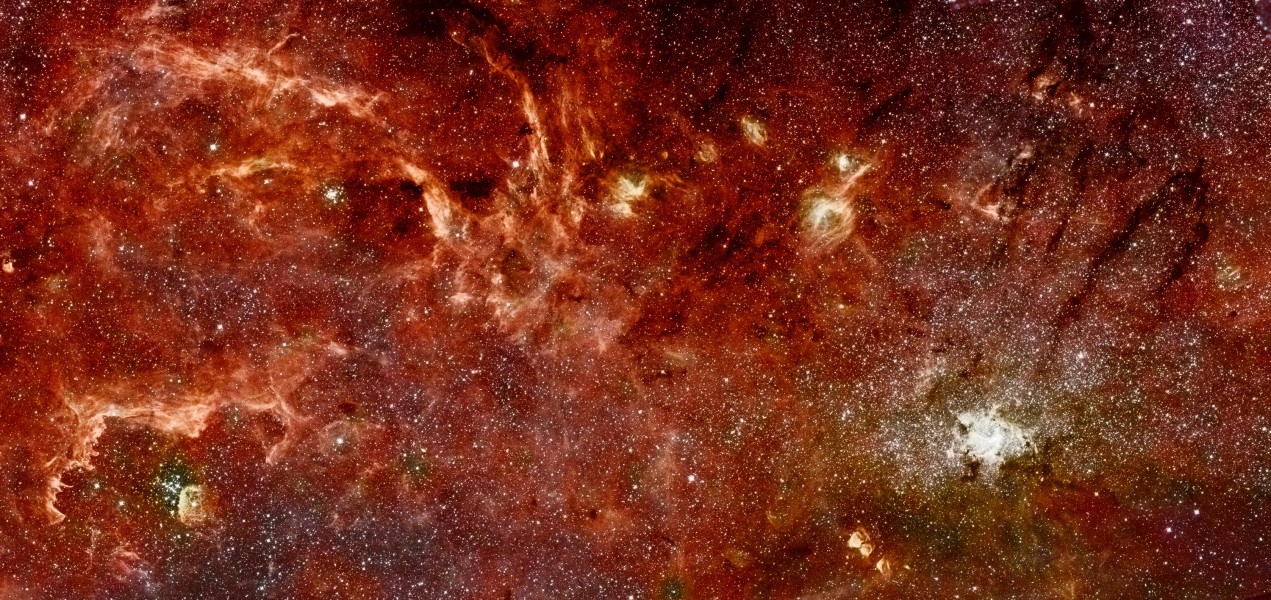
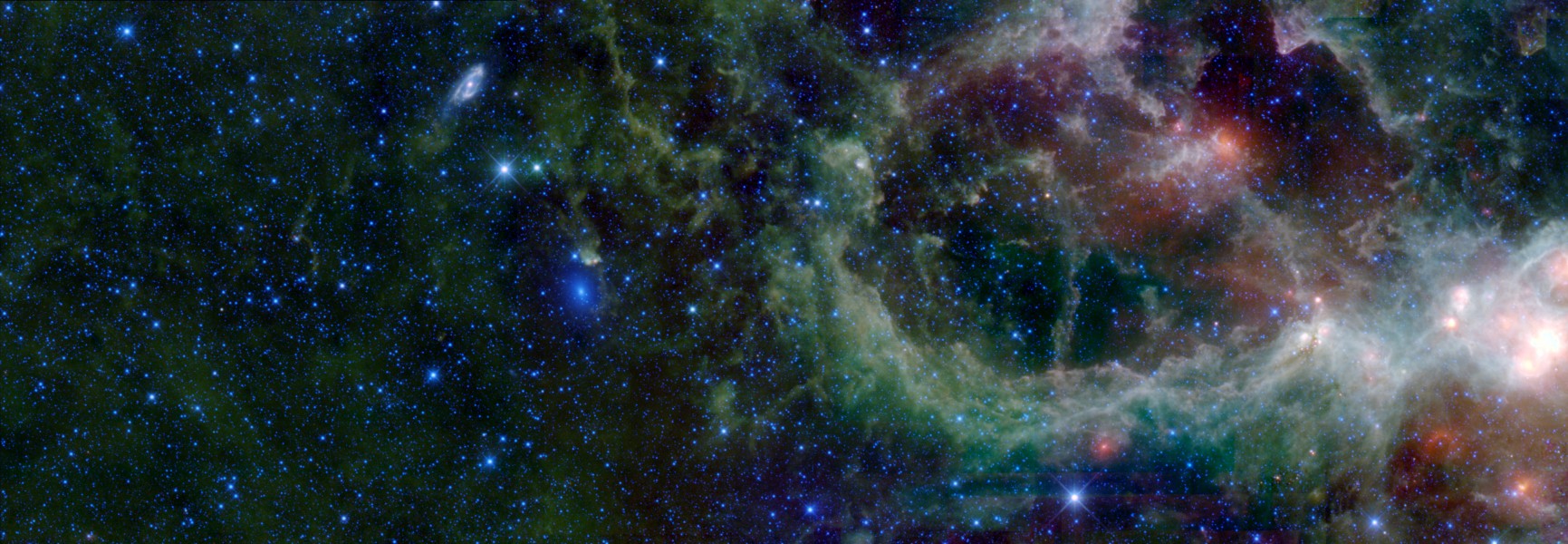
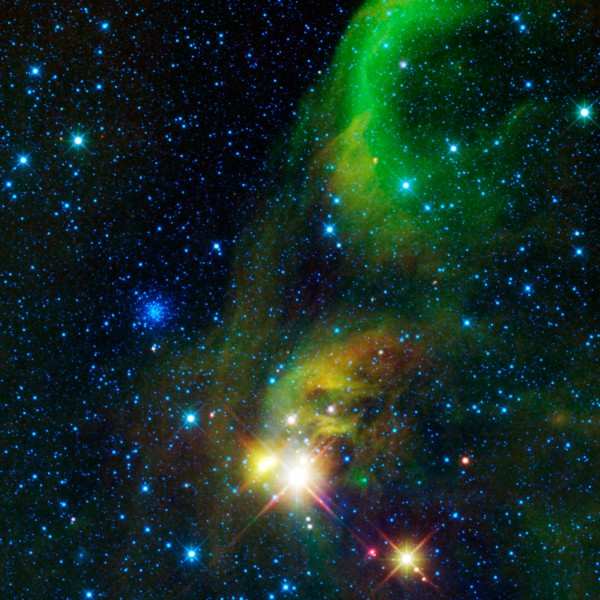
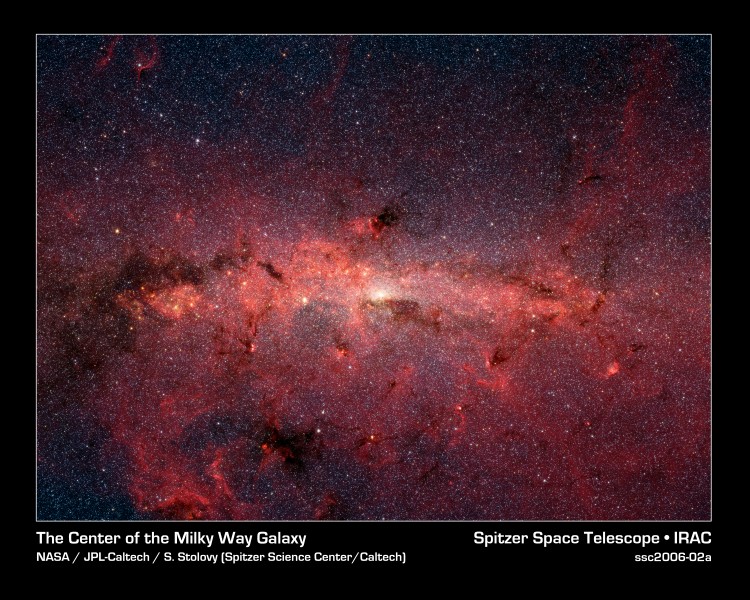
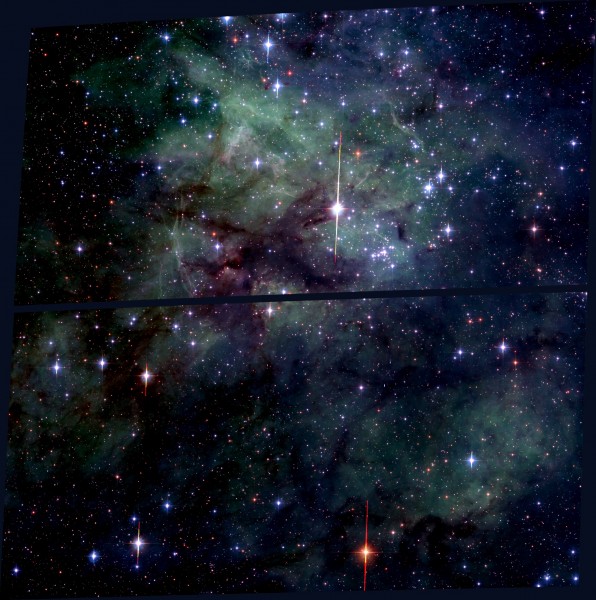
Original Caption Released with Image: This colorful image from NASA's WISE (Wide-field Infrared Survey Explorer) is a view of an area of the sky over 12 times the size of the full Moon on the border of the constellations Sagittarius and Corona Australis. Two types of star clusters are visible in the image.
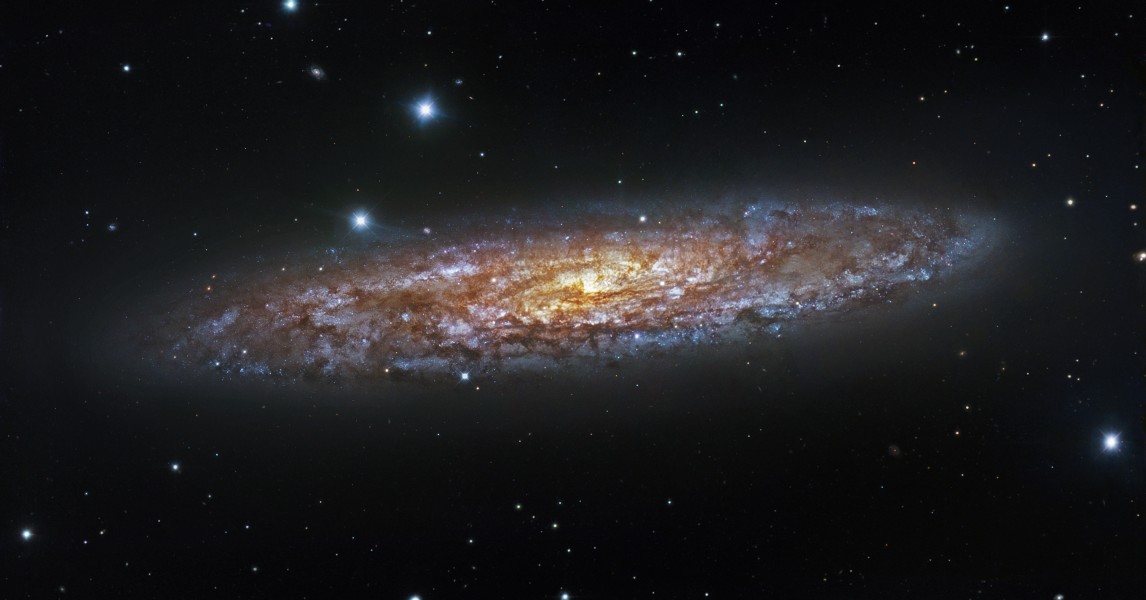
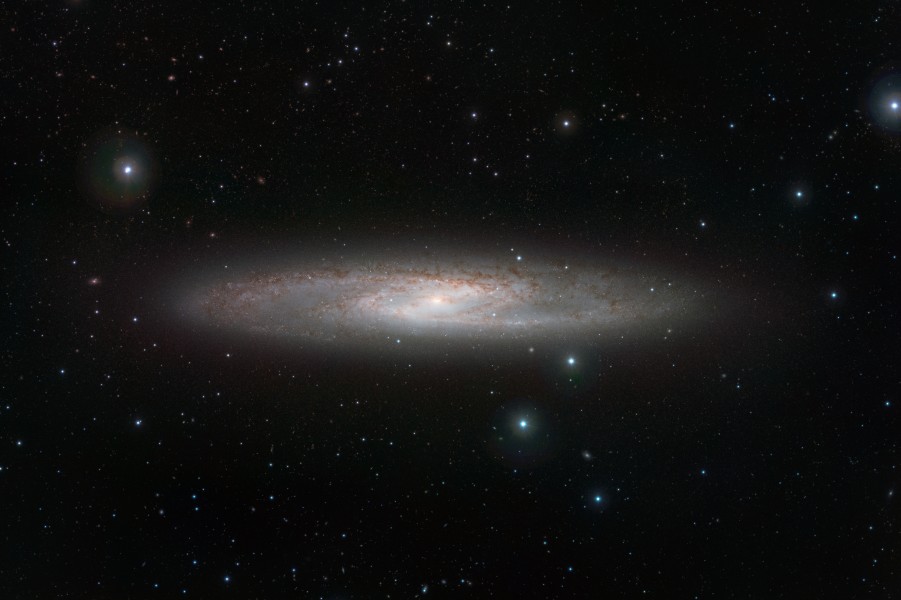
NGC 253, also known as the Sculptor Galaxy, is the brightest of the Sculptor Group of galaxies, found in the constellation of the same name, and lying approximately 13 million light-years from Earth. The Sculptor Galaxy is known as a starburst galaxy for its current high rate of star formation, one result of which is its superwind, a stream energetic material spewing out from the center of the galaxy out into space. The purple light comes from that frenzy of star formation, which originally began 30 million years ago, while the yellowish color is created by dust lit up by young, massive stars.
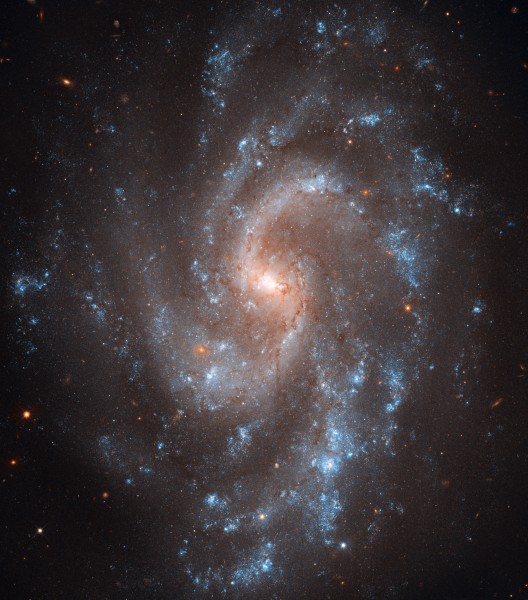
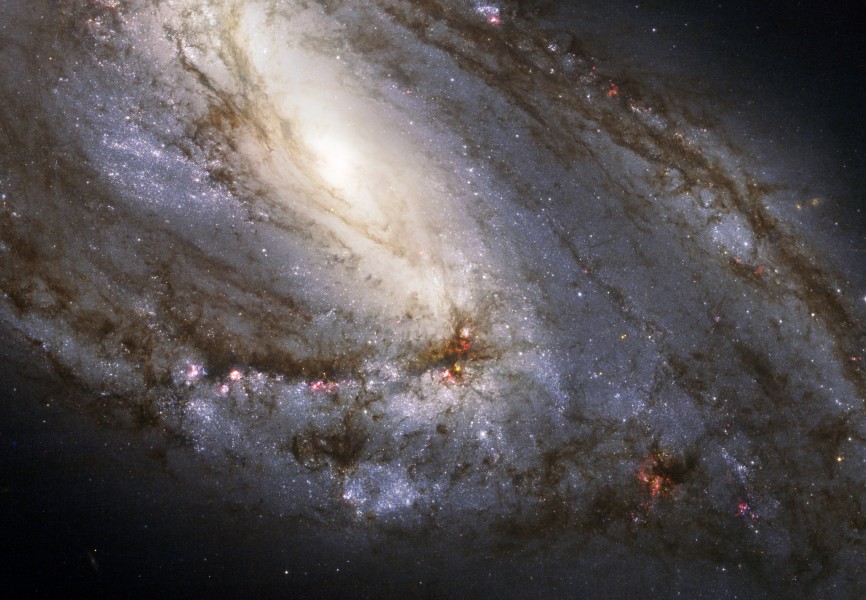
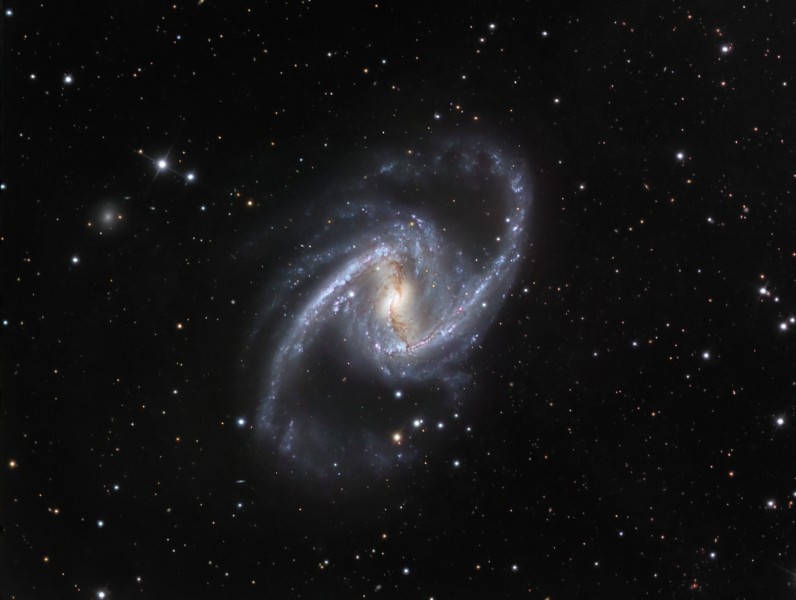
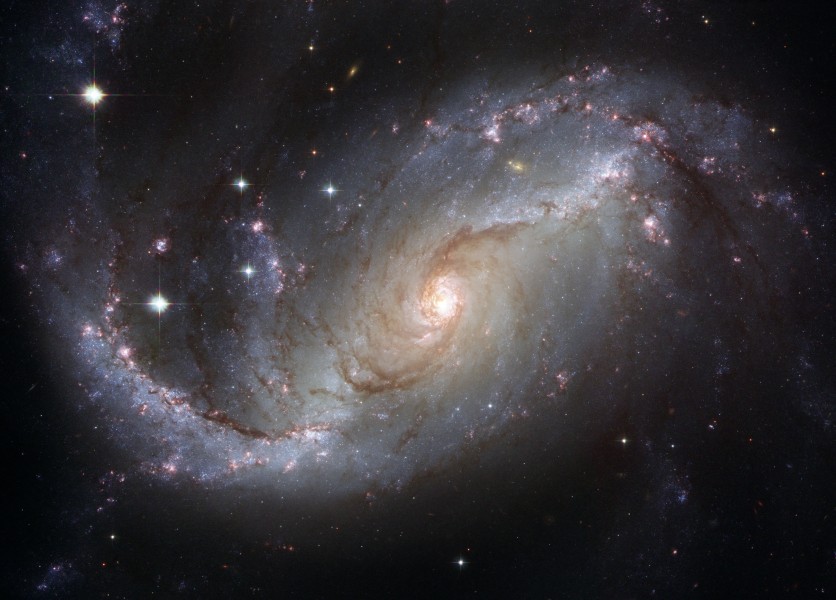
View of the nearby barred spiral galaxy NGC 1672 by NASA Hubble Space Telescope.
NASA's Spitzer Space Telescope has imaged a wild creature of the dark — a coiled galaxy with an eye-like object at its center.The 'eye' at the center of the galaxy is actually a monstrous black hole surrounded by a ring of stars. In this color-coded infrared view from Spitzer, the area around the invisible black hole is blue and the ring of stars, white.
The galaxy, called NGC 1097 and located 50 million light-years away, is spiral-shaped like our Milky Way, with long, spindly arms of stars.
The black hole is huge, about 100 million times the mass of our sun, and is feeding off gas and dust, along with the occasional unlucky star. Our Milky Way's central black hole is tame in comparison, with a mass of a few million suns.
The ring around the black hole is bursting with new star formation. An inflow of material toward the central bar of the galaxy is causing the ring to light up with new stars. And, the galaxy's red spiral arms and the swirling spokes seen between the arms show dust heated by newborn stars. Older populations of stars scattered through the galaxy are blue. The fuzzy blue dot to the left, which appears to fit snugly between the arms, is a companion galaxy. Other dots in the picture are either nearby stars in our galaxy, or distant galaxies.
This image was taken during Spitzer's cold mission, before it ran out of liquid coolant. The observatory's warm mission is ongoing, with two infrared channels operating at about 30 degrees Kelvin (-406 degrees Fahrenheit).
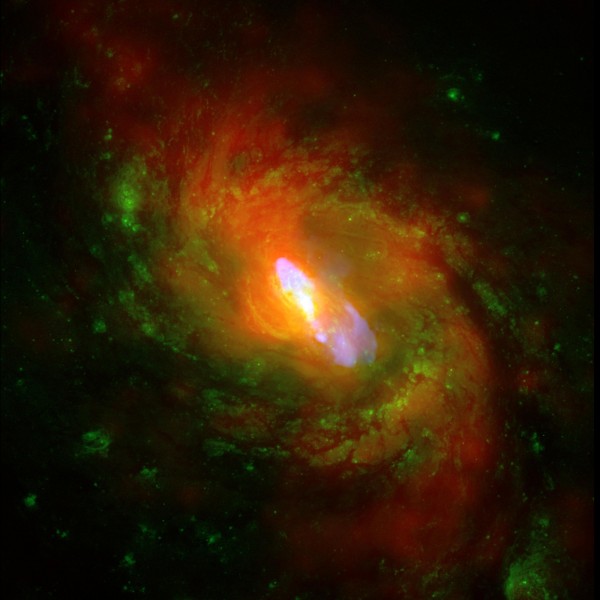
This is a composite image of NGC 1068, one of the nearest and brightest galaxies containing a rapidly growing super-massive black hole. The X-ray images and spectra obtained using Chandra's High Energy Transmission Grating Spectrometer show that a strong wind is being driven away from the centre of NGC 1068 at a rate of about a million miles per hour. This wind is likely generated as surrounding gas is accelerated and heated as it swirls toward the black hole. A portion of the gas is pulled into the black hole, but some of it is blown away. High energy X-rays produced by the gas near the black hole heat the ouflowing gas, causing it to glow at lower X-ray energies. X-ray data from the Chandra X-ray Observatory are shown in red, optical data from the Hubble Space Telescope in green and radio data from the Very Large Array in blue. The spiral structure of NGC 1068 is shown by the X-ray and optical data, and a jet powered by the central super-massive black hole is shown by the radio data.
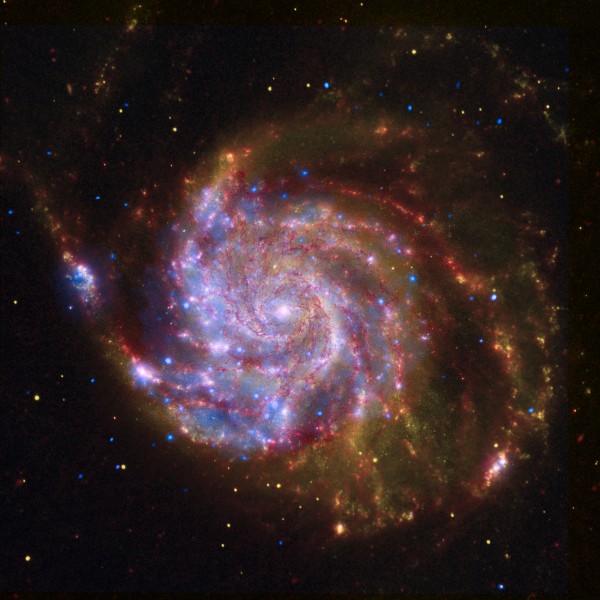
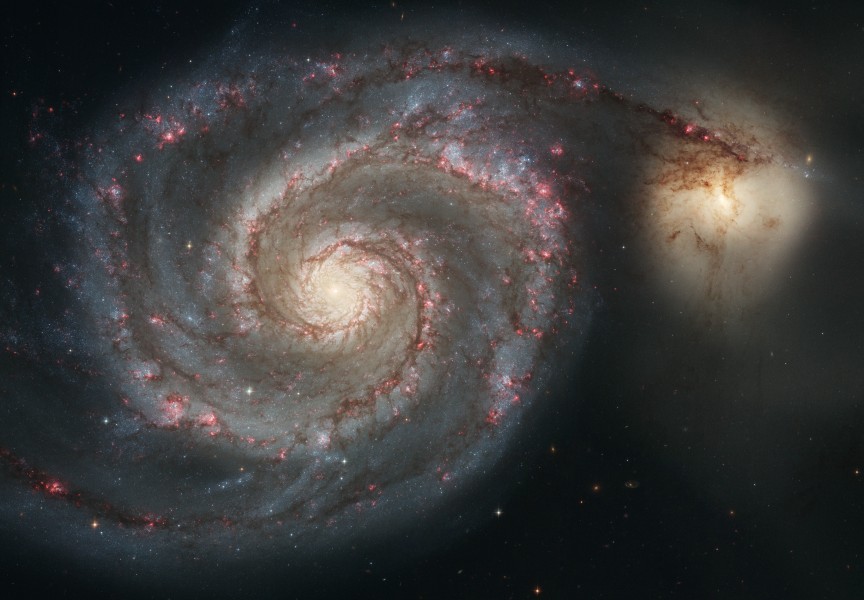
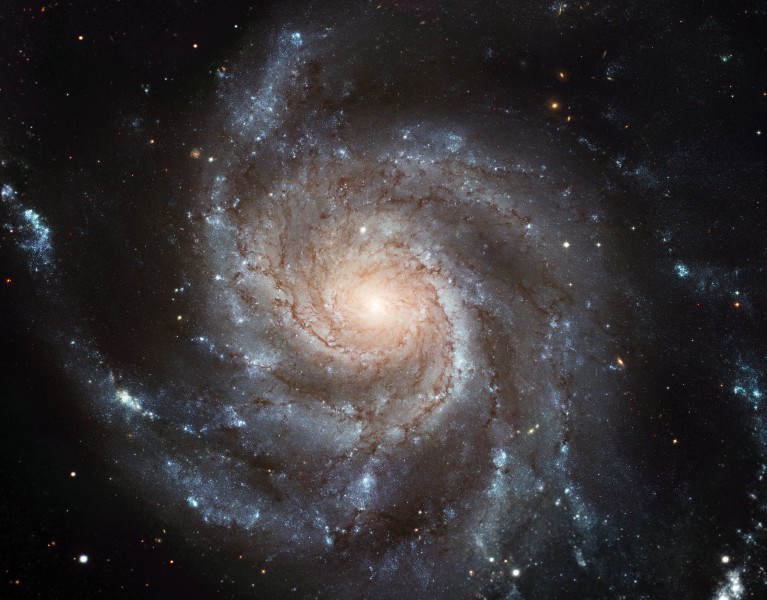
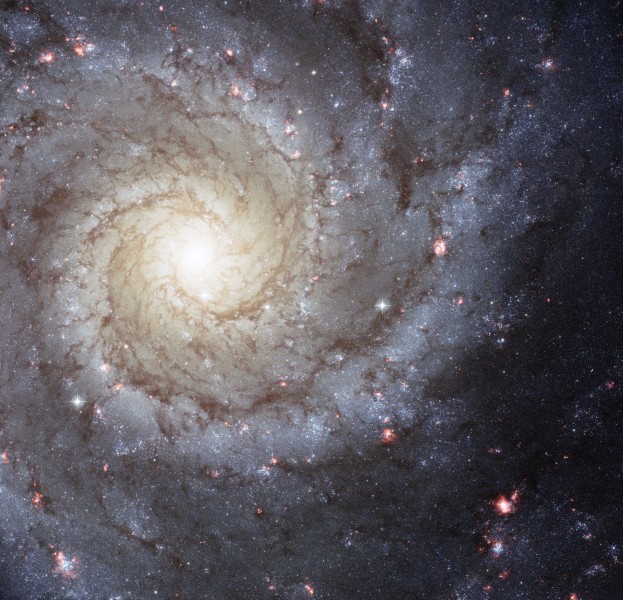
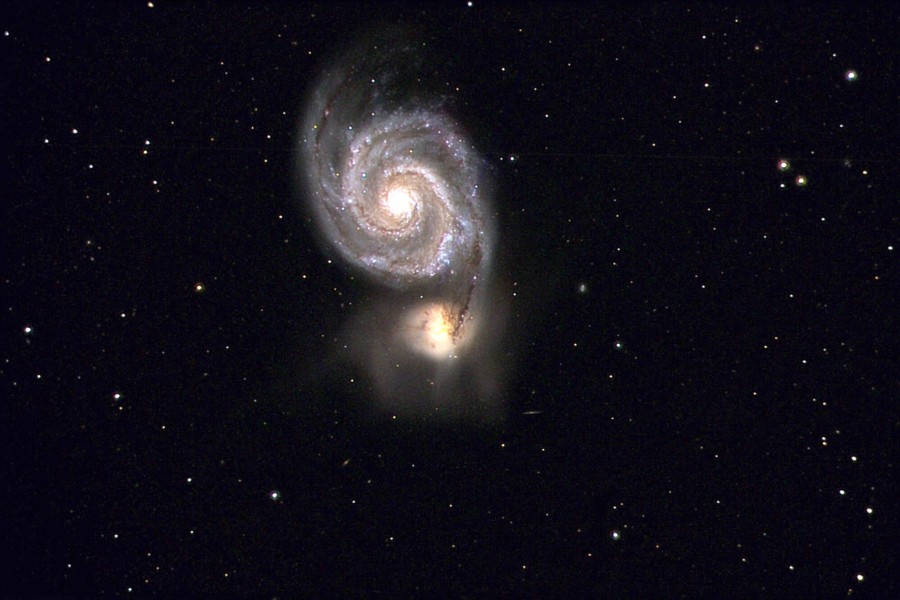
The tangled arms of the Pinwheel galaxy, otherwise known as Messier 101, are decked out in red in this new infrared image from NASA's Spitzer Space Telescope.
The Pinwheel galaxy is located 27 million light-years away in the constellation Ursa Major. It is what's called a flocculent spiral, which means that its spiral arms are not well defined.
The red color shows the dust, while the blue glow around the galaxy is from starlight.
In this infrared composite, blue indicates light with a wavelength of 3.6 microns, green corresponds to 4.5 microns, and red to 5.8 and 8.0 microns. The contribution from starlight (measured at 3.6 microns) has been subtracted from the 5.8- and 8-micron images to enhance the visibility of the dust features.
ABOUT THIS IMAGE:
This image of the spiral galaxy Messier 101 is a composite of views from the Spitzer Space Telescope, Hubble Space Telescope, and Chandra X-ray Observatory. Each wavelength region shows different aspects of celestial objects and often reveals new objects that could not otherwise be studied. The red color shows Spitzer's view in infrared light. It highlights the heat emitted by dust lanes in the galaxy where stars can form. The yellow color is Hubble's view in visible light. Most of this light comes from stars, and they trace the same spiral structure as the dust lanes. The blue color shows Chandra's view in X-ray light. Sources of X-rays include million-degree gas, exploded stars, and material colliding around black holes. Such composite images allow astronomers to see how features seen in one wavelength match up with those seen in another wavelength. It's like seeing with a camera, night vision goggles, and X-ray vision all at once.
Object Names: M101, NGC 4547, The Pinwheel Galaxy
Image Type: Astronomical
Credit: NASA, ESA, CXC, SSC, and STScI
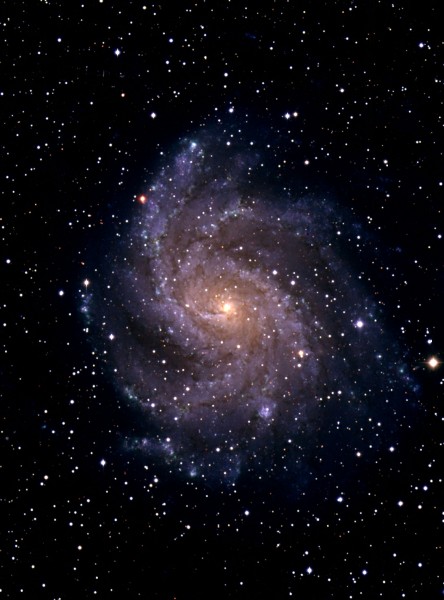
NGC6946. NGC 6946 (Arp 29) is a face-on SAB(rs)cd galaxy in the constellation Cygnus. This classification refers to the presence of a small core with multiple well-defined arms (cd), with a poorly-developed bar across the middle (AB) and an inner confused ring (rs). Nearly twenty million light years from Earth, it is over seventy thousand light years across.
Date: 1999.
Technical information: Image taken using the Wide Field Camera on the Isaac Newton Telescope
Image Credit: NASA/JPL-Caltech/R. Kennicutt (U. of Ariz./Inst. of Astr., U. of Cambridge) and the SINGS Team
Instrument: IRAC, Spitzer Space Telescope
Wavelength: 3.6 (blue), 4.5 (green), 5.8-8.0 (red) microns
Location of SN 1979C in Messier 100
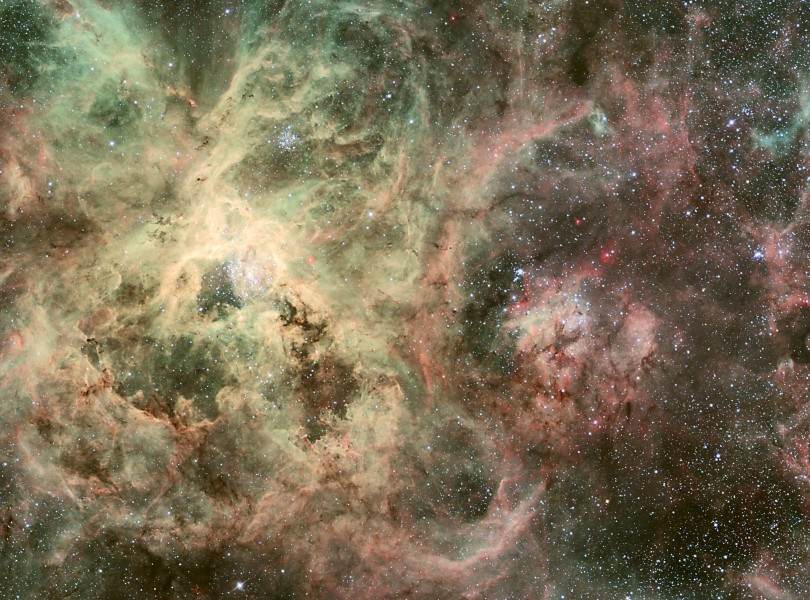
Part of the Tarantula Nebula, a giant HII region in the Large Magellanic Cloud. The star cluster at the lower right is Hodge 301.
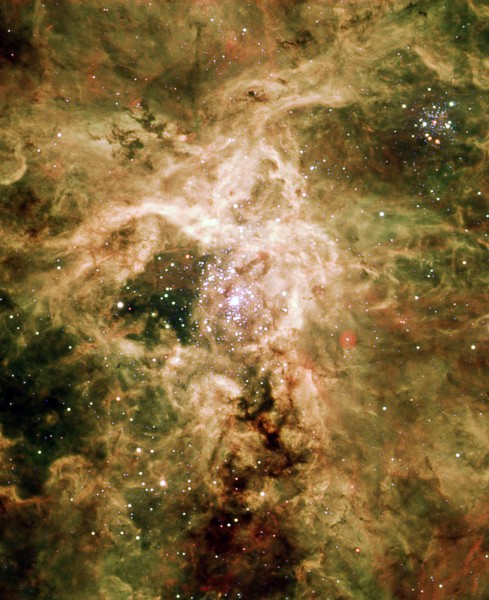
Central portion of the Tarantula Nebula.
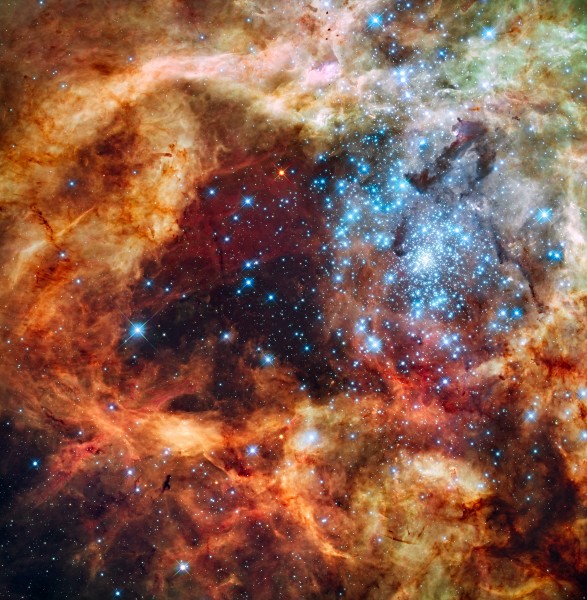
A heavy runaway star is rushing away from a nearby stellar nursery at more than 250,000 miles an hour, a speed at which one could travel to the our moon and back in two hours. This is the most extreme case of a very massive star that has been kicked out of its home by a group of even heftier siblings. The homeless star is on the outskirts of the 30 Doradus Nebula, a raucous stellar breeding ground in the nearby Large Magellanic Cloud. The stellar nursery is seen at the centre of this image. The finding bolsters evidence that the most massive stars in the local universe reside in 30 Doradus, making it a unique laboratory for studying heavyweight stars. Also called the Tarantula Nebula, 30 Doradus is roughly 170,000 light-years from Earth. Tantalizing clues from three observatories, including the Hubble Space Telescope's newly installed Cosmic Origins Spectrograph (COS), and some old- fashioned detective work, suggest that the star may have travelled about 375 light-years from its suspected home, a giant star cluster called R136. Nestled in the core of 30 Doradus, R136 contains several stars topping 100 solar masses each.
A Hubble Space Telescope image of the R136 super star cluster, near the center of the 30 Doradus Nebula, also known as the Tarantula Nebula or NGC 2070. Converted to JPG from the source TIFF file.
NGC 2070 by ESO
The LMC is a satellite galaxy to our Milky Way system, located in the southern constellation Dorado (The Swordfish) at a distance of approximately 170,000 light-years. The image is based on 15 exposures in the visual part of the spectrum with the Wide Field Imager (WFI) camera on the 2.2-m MPG/ESO telescope at the La Silla Observatory. A number of small areas near the borders were not covered in all three colours and have been left black. Six smaller fields with particular objects from this photo are reproduced as PR Photos 14b-g/02. PR Photo 14a/02 was produced from 15 images that were obtained in September 2000 with the Wide-Field-Imager (WFI) at the 2.2-m MPG/ESO telescope. The images were exposed in the B-band (5 x 200 sec; wavelength 456 nm; Full-Width-Half-Maximum (FWHM) 99 nm; here rendered as blue), V-band (5 x 200 sec; 540 nm; 89 nm; green) and R-band (5 x 200 sec; 652 nm; 162 nm; red). The original pixel size is 0.238 arcsec. The photo shows the full field recorded in all three colours. It measures approximately 34 x 34 arcmin 2 ; North is up and East is left. The seeing was about 1.6 arcsec.
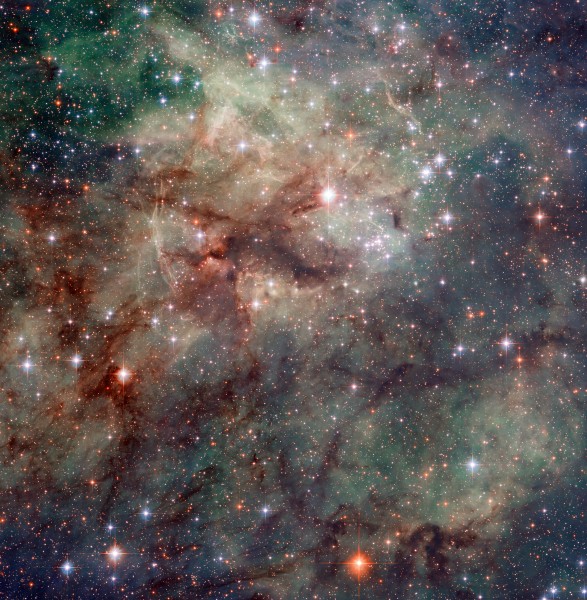
Hubble has taken this stunning close-up shot of part of the Tarantula Nebula. This star-forming region of ionised hydrogen gas is in the Large Magellanic Cloud, a small galaxy which neighbours the Milky Way. It is home to many extreme conditions including supernova remnants and the heaviest star ever found. The Tarantula Nebula is the most luminous nebula of its type in the local Universe.
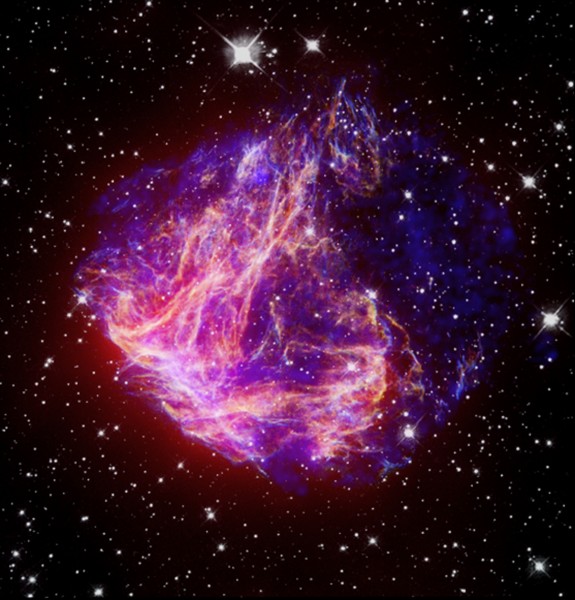
Located in the direction of the constellation Dorado in the Large Magellanic Cloud, the resplendent object known as NGC 2060 is the aftermath of a supernova. These powerful explosions serve as the death knell for massive stars, blasting heated matter out into surrounding space at great speed.
ID: NGC2060-cc
Credit: ESO
Stellar Debris in the Large Magellanic Cloud
PozostaЕ‚oЕ›c po supernowej w Wielkim ObЕ‚oku Magellana (Supernova Remnants)
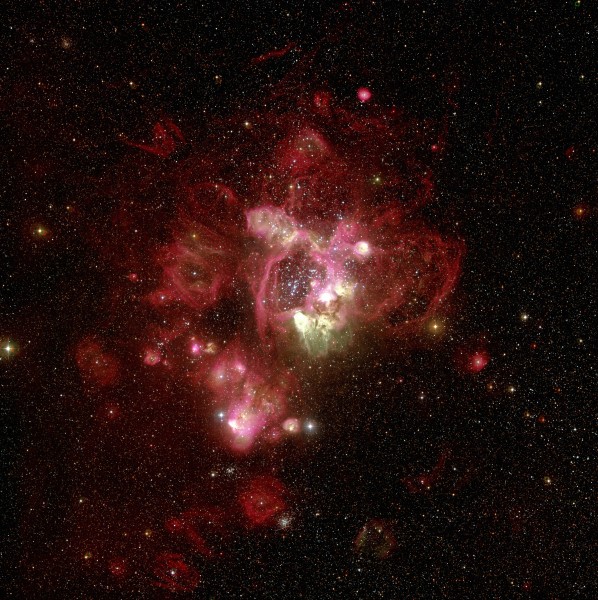
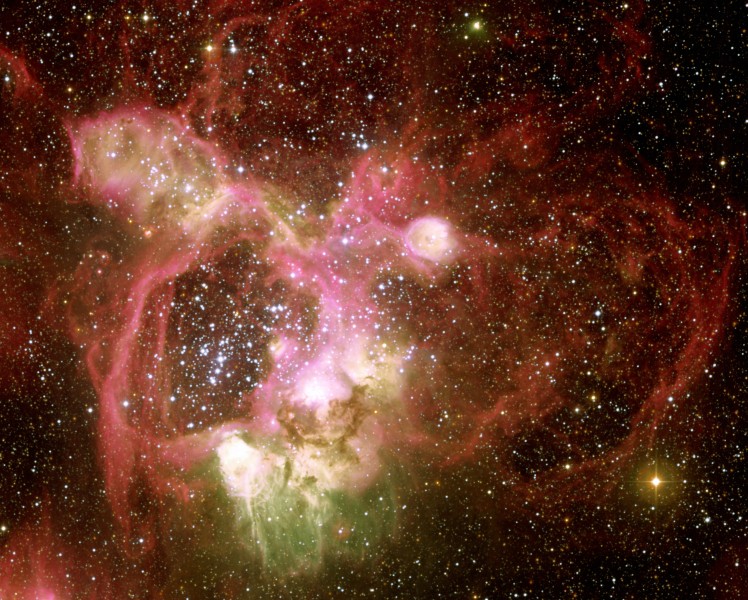
The centre of the associated nebular complex N44 in the Large Magellanic Cloud in more detail. The field size is 8.5 x 8.5 square arcminutes. North is up and East is left.
The star formation region N11B in the LMC taken by WFPC2 on the NASA/ESA Hubble Space Telescope.
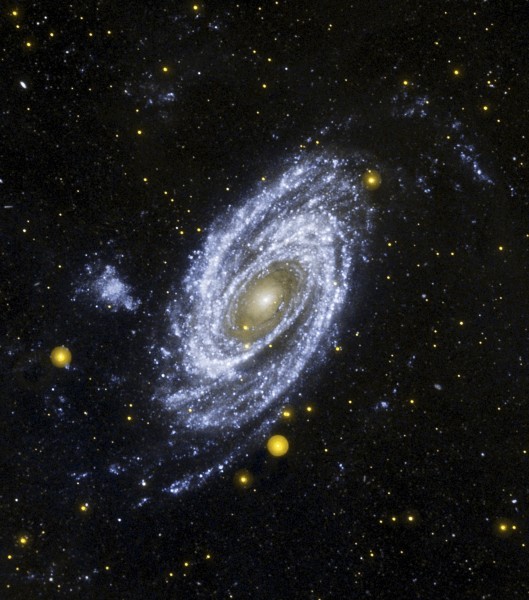
The spiral arms of the nearby galaxy Messier 81 are highlighted in this NASA Spitzer Space Telescope image. Located in the northern constellation of Ursa Major (which also includes the Big Dipper), this galaxy is easily visible through binoculars or a small telescope. M81 is located at a distance of 12 million light-years.
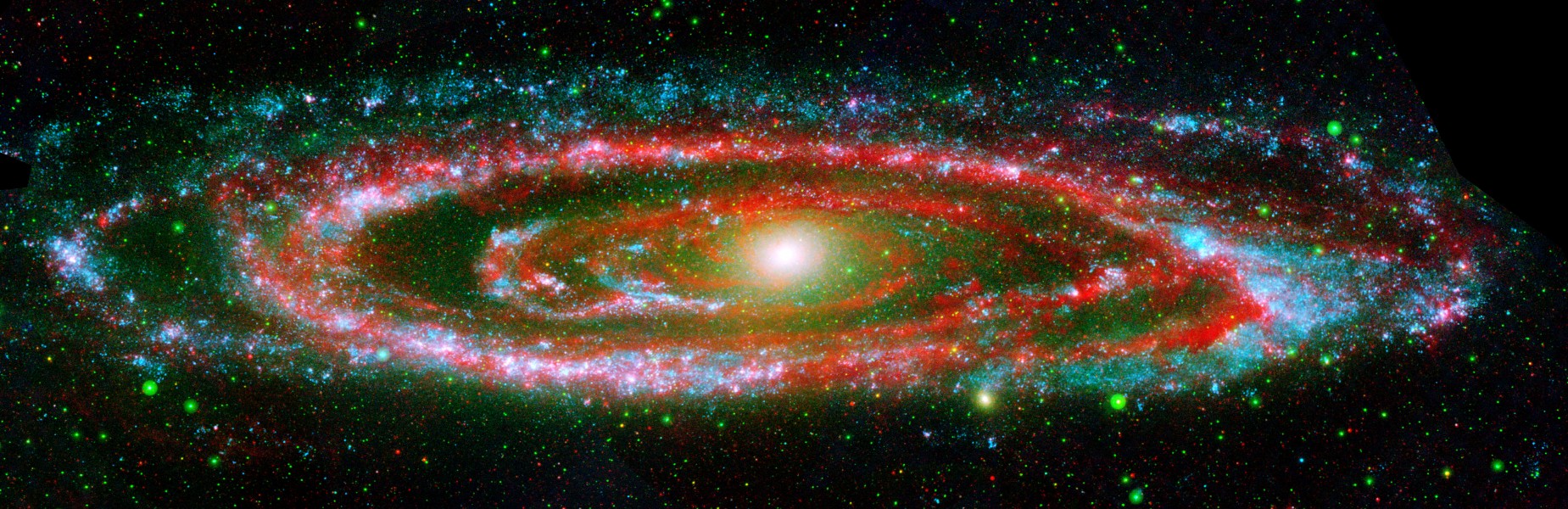
Andromeda Galaxy
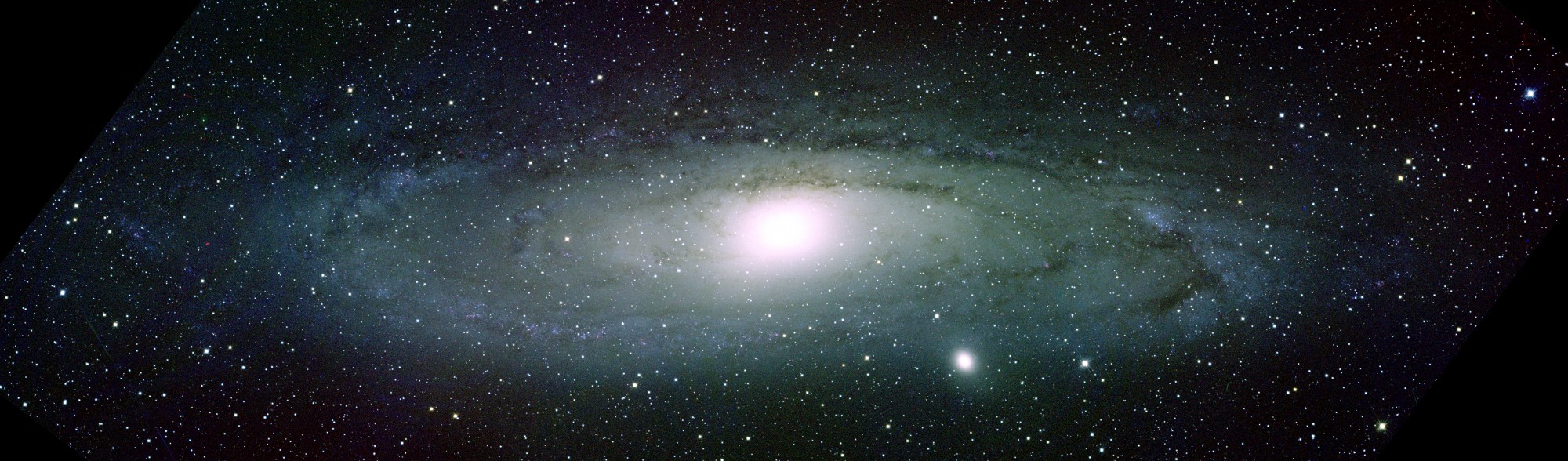
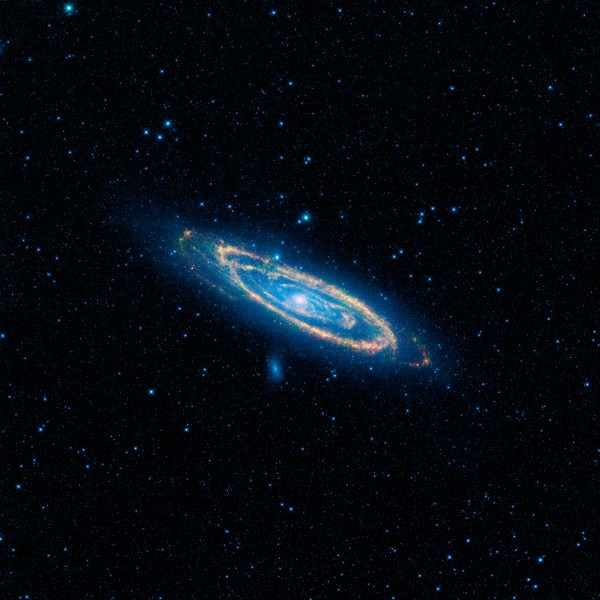
The immense Andromeda galaxy, also known as Messier 31 (M31), is captured in full in this new image from NASA's Wide-field Infrared Survey Explorer (WISE). The mosaic covers an area equivalent to more than 100 full moons, or five degrees across the sky. WISE used all four of its infrared detectors to capture this picture (3.4- and 4.6-micron light is colored blue; 12-micron light is green; and 22-micron light is red). Blue highlights mature stars, while yellow and red show dust heated by newborn, massive stars.
Andromeda is the closest large galaxy to our Milky Way galaxy, and is located 2.5 million light-years from our sun. It is close enough for telescopes to spy the details of its ringed arms of new stars and hazy blue backbone of older stars. Also seen in the mosaic are two satellite galaxies: M32, located just a bit above Andromeda to the left of center, and the fuzzy blue M110, located below the center of the great spiral arms. These satellites are the largest of several that are gravitationally bound to Andromeda.
Andromeda is larger than the Milky Way and contains more stars, but the Milky Way is thought to perhaps have more mass due to its larger proportion of a mysterious substance called dark matter. Both galaxies belong to our so-named Local Group, a collection of more than 50 galaxies, most of which are tiny dwarf systems. In its quest to map the whole sky, WISE will capture the entire Local Group.
This image from NASA's Wide-field Infrared Survey Explorer, or WISE, highlights the dust that speckles the Andromeda galaxy's spiral arms. It shows light seen by the longest-wavelength infrared detectors on WISE (12-micron light has been color coded orange, and 22-micron light, red).
The hot dust, which is being heated by newborn stars, traces the spidery arms all the way to the center of the galaxy. Telltale signs of young stars can also be seen in the centers of Andromeda's smaller companion galaxies, M32 and M110.
Andromeda, also called M31, is 2.5 million light-years away, and is the nearest large neighbor to our Milky Way galaxy.
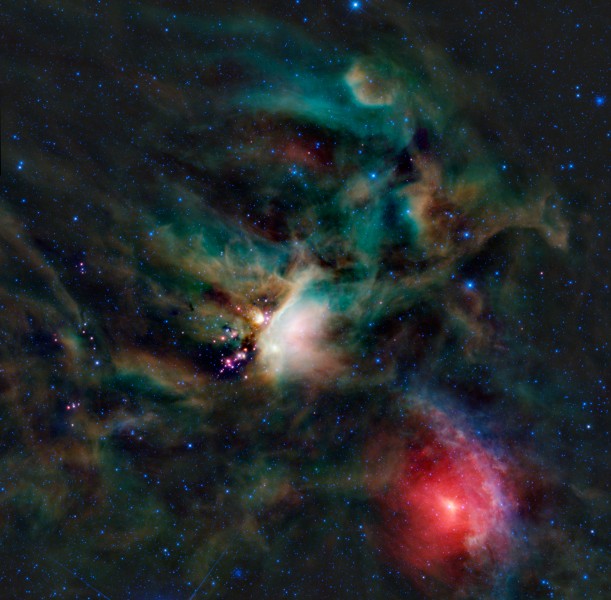
A rich collection of colourful astronomical objects is revealed in this picturesque image of the Rho Ophiuchi cloud complex from NASA’s Wide-field Infrared Explorer, or WISE. The Rho Ophiuchi cloud (pronounced �oh-fee-yoo-ki’ and named after a bright star in the region) is found rising above the plane of the Milky Way in the night sky, bordering the constellations Ophiuchus and Scorpius. It’s one of the nearest star-forming regions to Earth, allowing us to resolve much more detail than in more distant similar regions, like the Orion nebula.
The amazing variety of different colours seen in this image represents different wavelengths of infrared light. The bright white nebula in the centre of the image is glowing due to heating from nearby stars, resulting in what is called an emission nebula. The same is true for most of the multi-hued gas prevalent throughout the entire image, including the bluish bow-shaped feature near the bottom right. The bright red area in the bottom right is light from the star in the centre – Sigma Scorpii – that is reflected off of the dust surrounding it, creating what is called a reflection nebula. And the much darker areas scattered throughout the image are pockets of cool dense gas that block out the background light, resulting in absorption (or �dark’) nebulae. WISE’s longer wavelength detectors can typically see through dark nebulae, but these are exceptionally opaque.
The bright pink objects just left of centre are young stellar objects (YSOs). These baby stars are just now forming; many of them are still enveloped in their own tiny compact nebulae. In visible light, these YSOs are completely hidden in the dark nebula that surrounds them, which is sometimes referred to as their baby blanket. We can also see some of the oldest stars in our Milky Way Galaxy in this image, found in two separate (and much more distant) globular clusters. The first cluster, M80, is on the far right edge of the image towards the top. The second, NGC 6144, is found close to the bottom edge near the centre. They both appear as small densely compacted groups of blue stars. Globular clusters such as these typically harbour some of the oldest stars known, some as old as 13 billion years, born soon after the Universe formed.
There are two other items of interest in this image as well. At the 3 o’clock position, relative to the bright central region, and about two-thirds of the way from the centre to the edge, there is a small faint red dot. That dot is an entire galaxy far, far away known as PGC 090239. And, at the bottom left of the image, there are two lines emerging from the edge. These were not created by foreground satellites; they are diffraction spikes (optical artefacts from the space telescope) from the bright star Antares that is just out of the field of view.
This infra-red image from NASA’s WISE (Wide-field Infrared Survey Explorer) features one of the bright stars in the constellation Perseus, named Menkhib (the bright star in the upper left near the red dust cloud) along with a large star forming cloud catalogued as NGC 1499, or more commonly called the California Nebula (running diagonally through the image). Menkhib is one of the hottest stars visible in the night sky; its surface[]Sun). Because of its high temperature it appears blue-white to the human eye (almost all stars appear bluish to WISE). It has about 40 times the mass of the Sun and gives off 330,000 times the amount of light. Menkhib is a runaway star, and the fast stellar wind it blows is piling up in front of it to create a shock wave in the gas and dust surrounding it in the space between the stars. This shock wave is heating up the dust within and WISE sees it as the red cloud in the upper left of the image. Menkhib is part of an association of very hot stars that were born from the California Nebula only a few million years ago. These stars are lighting up the nebula; heating and ionizing it. In visible light, the ionized gas glows red, while in infra-red light we see the heated dust (which appears in green and red in this image from WISE). The California Nebula gets its name due to a resemblance to the shape of the U.S. State of California (which you can just make out as outlined by the green dust if you rotate the image by a little more than 90 degrees clockwise). The entire California Nebula stretches across about 100 light-years, and we see about 80% of it in this view.
A mosaic of images from WISE in the constellation of Cassiopeia. This region contains a large star forming nebula within the Milky Way Galaxy, called IC 1805 (sometimes called the Heart Nebula), a portion of which is seen at the right of the image. IC 1805 is over 6 thousand light-years from Earth. Also visible in this image are two nearby galaxies, Maffei 1 and Maffei 2. In visible light these galaxies are hidden by dust in IC 1805 and were unknown until 1968 when Paolo Maffei found them using infra-red observations. Both galaxies contain billions of stars and are located some 10 million light-years away (well outside our own Milky Way Galaxy). Maffei 1 is the bluish elliptical object in the centre of the image. It is a Lenticular type galaxy, which has a disk-like structure and a central bulge but no spiral structure or appreciable dust content. Maffei 2 (to the upper left of Maffei 1) is a Spiral type galaxy that also has a disk shape, but with a bar-like central bulge and two prominent dusty spiral arms.
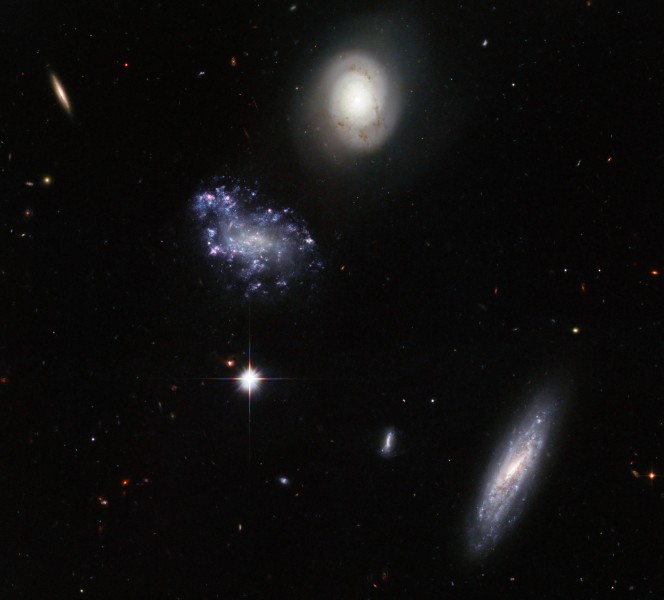
M81 and Holberg IX are located approximately 12 million light-years away in the northern constellation Ursa Major. In addition to leading the GALEX observations of M81, Huchra and his team also took observations of the region with NASA's Spitzer and Hubble space telescopes. By combining all these views of M81, Huchra hopes to gain a better understanding about how M81 has developed into the spiral galaxy we see today.
NGC 4214
ESO 99-4 is a galaxy with a highly peculiar shape that is probably the remnant of an earlier merger process that has deformed it beyond visual recognition, leaving the main body largely obscured by dark bands of dust. ESO 99-4 lies in a rich field of foreground stars, in the constellation of Triangulum Australe, the Southern Triangle, about 400 million light-years away.
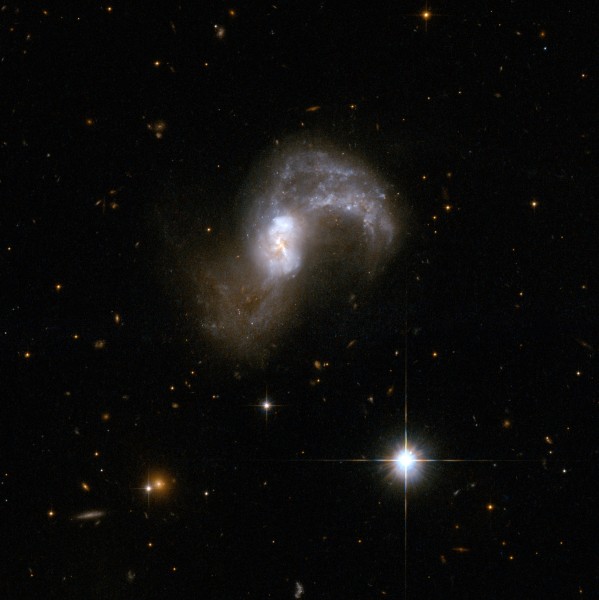
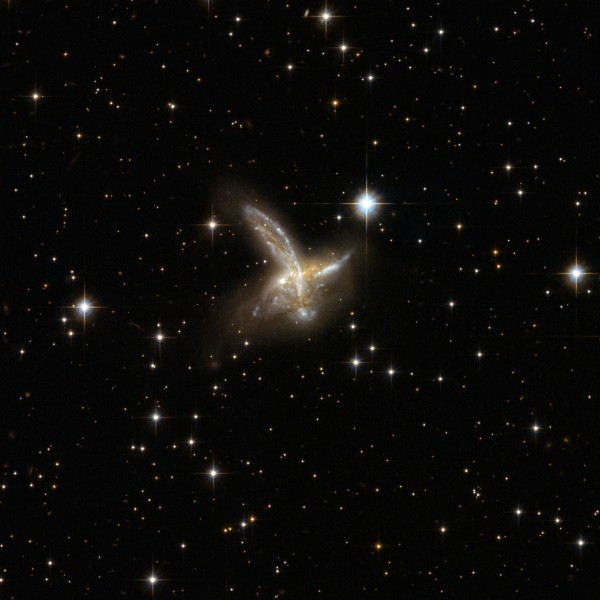
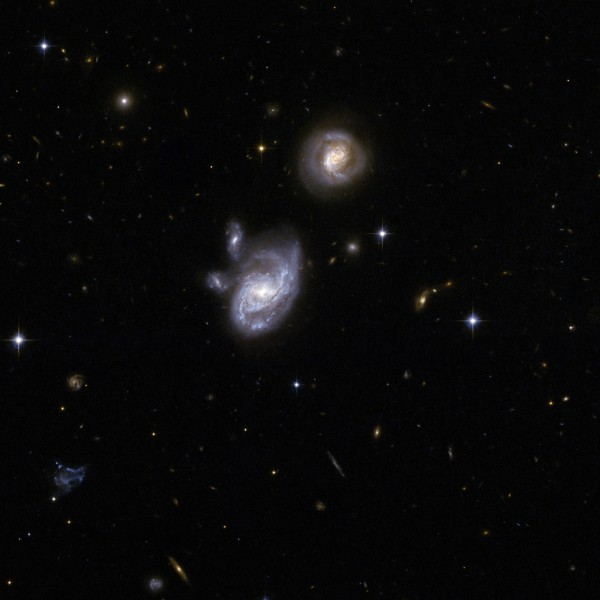
ESO 593-8 is an impressive pair of interacting galaxies with a feather-like galaxy crossing a companion galaxy. The two components will probably merge to form a single galaxy in the future. The pair is adorned with a number of bright blue star clusters. ESO 593-8 is located in the constellation of Sagittarius, the Archer, some 650 million light-years away from Earth.
Amazing Andromeda Galaxy
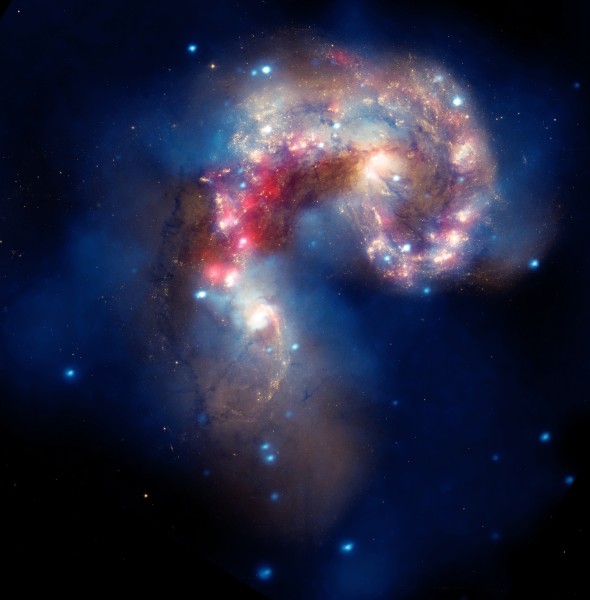
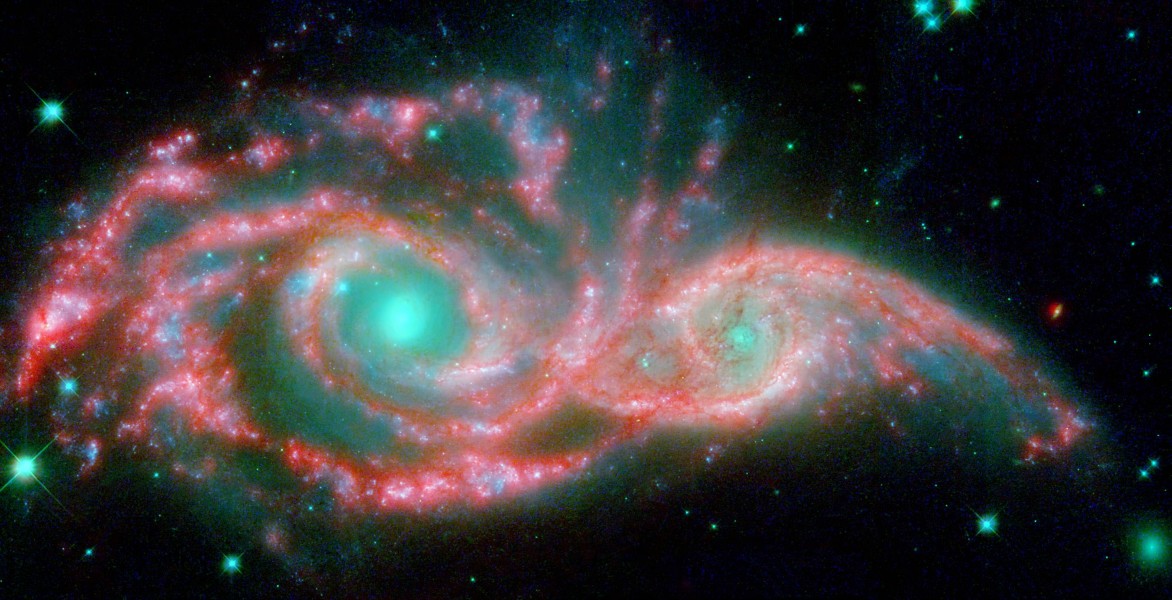
These shape-shifting galaxies have taken on the form of a giant mask. The icy blue eyes are actually the cores of two merging galaxies, called NGC 2207 and IC 2163, and the mask is their spiral arms. The false-color image consists of infrared data from NASA's Spitzer Space Telescope (red) and visible data from NASA's Hubble Space Telescope (blue/green).
NGC 2207 and IC 2163 met and began a sort of gravitational tango about 40 million years ago. The two galaxies are tugging at each other, stimulating new stars to form. Eventually, this cosmic ball will come to an end, when the galaxies meld into one. The dancing duo is located 140 million light-years away in the Canis Major constellation.
This image shows a three-colour composite image of the Chandra Deep Field South (CDF-S) , obtained with the Wide Field Imager (WFI) camera on the 2.2-m MPG/ESO telescope at the ESO La Silla Observatory (Chile). It was produced by the combination of about 450 images with a total exposure time of nearly 50 hours. The field measures 36 x 34 arcmin 2 ; North is up and East is left.


Photos offered at Free-Photos.Biz come from Wikimedia Commons and from other sources. The pictures are published under free licenses and can be used by you free of charge for commercial and non-commercial purposes.
See more at: here and here.If you want to be sure of the concrete free license of a picture - look for the same picture at commons.wikimedia.org and see the license conditions there - but remember not all pictures come from there.

Some photos portray identifiable persons alive or deceased recently. The use of images of living or recently deceased individuals is, in some jurisdictions, restricted by laws pertaining to personality rights, independent from their copyright status. Before using such photos, please ensure that you have the right to use them under the laws which apply in the circumstances of your intended use. You are solely responsible for ensuring that you do not infringe someone else's personality rights.
christian portal